Free Field Level Hazard Assessment (FLHA) Template
An FLHA is a short hazard assessment done at the work location, before work starts each shift or task, and again when conditions change. This template records the date and time, the tasks, the hazards, the controls, the crew who took part and any re-assessment during the shift. It is built around Alberta's OHS Code Part 2, the most explicit rules in Canada, and works as a field record in other provinces too.
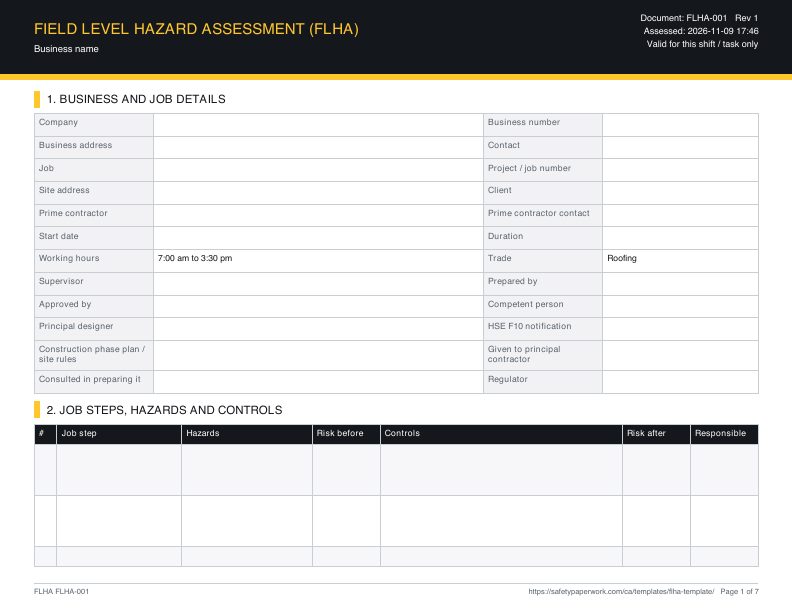
Field Level Hazard Assessment template
Word (.docx, editable) and PDF (Letter, print ready). No email needed.
When you need a FLHA
- Alberta: the employer must assess the work site and identify existing and potential hazards before work begins, prepare a report, and record the date it was prepared or revised (OHS Code s.7(1) to (3)).
- Alberta: the assessment must be repeated at reasonable intervals, when a new work process is introduced, when a process or operation changes, and before significant additions or alterations to the site (s.7(4)).
- Alberta: affected workers must be involved in the hazard assessment and in controlling the hazards (s.8(1)).
- Ontario: employers must acquaint workers with any hazard in the work and take every precaution reasonable for their protection (OHSA s.25(2)(d) and (h)); supervisors must advise workers of known dangers (s.27(2)(a)).
- British Columbia: employers must remedy hazardous conditions and make workers aware of all known or reasonably foreseeable hazards (Workers Compensation Act s.21(2)).
- No province names a document called an FLHA. Prime contractors and COR audits expect a site-specific assessment before work starts each day, involving the affected workers.
What goes in each field
| Field | What to write | Example |
|---|---|---|
| Date and time | The date and time the assessment was done, and the date of any revision. | 3 March 2026, 7:10 am |
| Employer, prime contractor and site | Your company, the prime contractor (constructor in Ontario), and the exact work location. | Northline Exteriors for Prairie Homes (prime contractor), 88 Aspen Way, Red Deer, rear elevation |
| Task description | The work being done this shift, in plain words. | Remove and replace 30 m of eavestrough and two downspouts on a two storey house |
| Permits and locates | Any permit or locate needed, with its number. | None needed today; overhead service drop confirmed with owner |
| Hazards | Hazards at this location today: from the task, the site, the weather and other trades. | Fall from ladder or eave edge, 6 m; service drop 1 m from the gutter line; icy ground at ladder foot |
| Controls | How each hazard is eliminated or controlled: engineering first, then administrative, then PPE. | Scissor lift on firm ground instead of ladder; utility to sleeve the service drop; sand at base |
| Hazardous products (WHMIS) | Products with WHMIS labels used today, and where the safety data sheets (SDS) are kept. | Gutter sealant (flammable aerosol); SDS in the truck binder |
| Fall protection plan | If anyone may fall 3 m or more without guardrails (Alberta), or 7.5 m or more (BC): the system, anchors, clearance and rescue procedure, or where the written plan is kept. In Ontario, write the rescue procedure before anyone uses fall arrest. | Guardrails on scissor lift; harness not used; plan in truck binder |
| Pre-job checks | Yes or no checks: PPE inspected, tools inspected, barricades up, emergency plan and muster point reviewed, working alone check-in set. | PPE yes; lift pre-use check yes; barricade tape at driveway yes; muster point front lawn |
| Crew participation and signatures | Every worker signs to show they took part and the hazards and controls were reviewed with them before work started. | K. Singh, M. Dubois, R. Clarke signed 7:20 am |
| Re-assessment when conditions change | Time, what changed, new hazards, new controls, initials. | 11:30 am: wind rising, lift stowed, ground work only until it drops. K.S. |
| Supervisor review and end of shift | Supervisor signature, and at the end: area cleaned up, hazards left, incidents. Fill these in at the end, not at the start. | End 3:45 pm: area clear, new gutter not yet sealed at corner, no incidents. Supervisor: K. Singh |
How to fill it in
- Fill it in at the work location, before work starts, with the whole crew there.
- Write the date, time, site location, task and the prime contractor.
- Look around the work area and list the hazards you can see today, plus the ones the task brings.
- For each hazard, write the control: eliminate it if you can, then engineering, then procedures, then PPE.
- Do the pre-job checks and record permit or locate numbers.
- Review it with every worker and have each one sign before starting.
- Stop and add a re-assessment entry whenever conditions, tasks or crew change.
- At the end of the shift, complete the close-out section and hand the form in with the job file.
Why FLHAs get rejected
- End of shift boxes already say "None" when the form was signed at the start of the shift.
- One FLHA reused for days or weeks, or a "review by" date a month away, when the work and conditions change daily.
- No time of assessment and no record of any revision, which Alberta s.7(3) requires.
- Workers signed that they "read" it, but nothing shows they took part, which Alberta s.8(1) requires.
- Work at height with no fall protection plan where the province requires one, or no written rescue procedure for workers using fall arrest.
- Permits or locates required on site but no permit or ticket numbers recorded.
- No re-assessment entry after an obvious change such as weather, a new task or a new crew member.
Filled FLHA examples
Questions
Is a free FLHA template compliant?
A blank template can't be compliant on its own; the completed assessment is what counts. Alberta's own sample site-specific assessment says that completing a template alone will not necessarily put you in compliance and that you must customize it for your work site. Fill in real hazards and controls and involve the crew.
Source: Alberta OHS: Site-specific hazard assessment (template)
Who signs an FLHA?
Every worker doing the task signs, and the supervisor or person who led the assessment signs as reviewer. In Alberta the employer must involve affected workers in the assessment and in controlling the hazards, and the signatures are the usual evidence that they took part.
Source: Alberta OHS Code Part 2, s.8
How long should I keep FLHAs?
Alberta's Part 2 does not set a retention period for hazard assessments. COR audits sample records from the past 12 months, and the Energy Safety Canada COR protocol expects safety records such as inspections and training to be kept for a full three-year audit cycle, so many employers keep FLHAs for three years.
Does an FLHA need a risk matrix?
No provincial law requires a risk matrix on an FLHA. Many prime contractor forms include a simple rating to help decide which hazards to deal with first; if yours does, rate the risk before and after controls. What auditors check is that hazards were found and controlled before work began.
Source: Alberta OHS Code Part 2
Do it on your phone instead
Fill it in by tapping, the crew signs with a finger, and you get a clean PDF.