Free SWMS Template (Safe Work Method Statement)
A SWMS is the document the WHS Regulations require before any high risk construction work starts. This template has the fields regulators and principal contractors look for: the high risk work, the hazards, the controls, and how those controls are put in place, checked and reviewed. Fill it in for the actual site, brief your crew on it, and hand a copy to the principal contractor before you start.
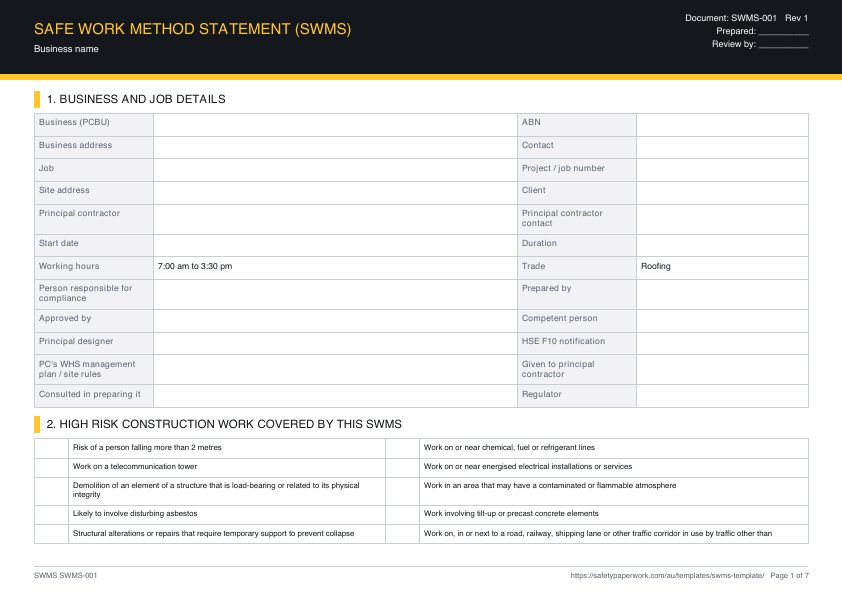
Safe Work Method Statement template
Word (.docx, editable) and PDF (A4, print ready). No email needed.
When you need a SWMS
- Before any high risk construction work (HRCW) starts. The business doing the work must make sure a SWMS has been prepared for it (WHS Regulations r.299(1)).
- HRCW is any of the 18 categories in r.291, such as a risk of a person falling more than 2 m, work on or near energised electrical installations or services, a trench or shaft deeper than 1.5 m, disturbing asbestos, and work in an area where powered mobile plant moves.
- On a construction project, a copy must be given to the principal contractor before the HRCW starts (r.301). Under the model regulations a construction project is construction work costing $250,000 or more; in WA it is a project where 5 or more people work on site at the same time.
- In Victoria the same duty is in the Occupational Health and Safety Regulations 2017. It applies to employers and self-employed persons, and WorkSafe Victoria lists 19 types of HRCW (tunnels are listed on their own).
- A SWMS is not needed for construction work that is not HRCW, or for work of a minor nature. The risks of that work still have to be managed.
What goes in each field
| Field | What to write | Example |
|---|---|---|
| Business details (PCBU) | Legal business name, ABN, address and phone of the business doing the work. In Victoria, write the employer or self-employed person. | Ridgeline Roofing Pty Ltd, 22 Depot Road, Penrith NSW, 02 4700 0000 |
| Principal contractor and date given to them | The builder in charge of the construction project, a site contact, and the date you actually handed over the SWMS. Leave the date blank until you give it to them. | Coastline Builders, site manager Dana Price 0400 111 222, given 3 March |
| Work activity and site | What you are doing and where, plus the site conditions that change how the work is done: height, roof pitch, access, power lines, neighbours, weather. | Replace 40 cracked concrete roof tiles, two storey house, 25 degree pitch, overhead service line at the front |
| High risk construction work ticked | Tick every HRCW category the job involves. Each tick should match at least one task in the table below. | Risk of a person falling more than 2 m; work near energised electrical installations or services |
| Tasks in order | The job broken into the steps the crew will actually follow, from setting up to packing down. | 1. Set up scaffold edge protection at the eaves. 2. Access the roof by a secured ladder. 3. Remove broken tiles. |
| Hazards and risks | For each task, what could hurt someone and how badly. Be specific to this roof, not a list of everything that could happen on any job. | Fall from the eaves edge onto the concrete driveway, about 6 m |
| Control measures | What will be done to control each risk, highest control first: eliminate, then substitute, isolate or engineer, then administrative controls, then PPE. | Scaffold edge protection along the full eaves before anyone goes on the roof; walk on tile laps only; harness to a ridge anchor where there is no edge protection |
| How controls are put in place, checked and reviewed | Who sets up each control, how compliance is checked during the job, and what triggers a review. | Leading hand checks edge protection and anchors at each pre-start; SWMS reviewed if the scope, crew or weather changes |
| Person responsible, reviewer and review date | The person who makes sure the SWMS is followed, the person who reviews it, and when. | Compliance: Jo Nguyen, leading hand 0412 000 000. Review: Mark Ellis, director, before each new stage |
| Emergency and rescue | Emergency number, nearest hospital, first aider, and a rescue plan if anyone will rely on a harness to stop a fall. | Call 000. Rescue kit in the ute, two workers trained to use it, aim to reach a suspended worker within minutes |
| Who was consulted | The workers (and health and safety representative, if there is one) who helped prepare or check the SWMS. | Crew of three at the pre-start on 3 March; no HSR on this site |
| Worker sign-on | Name, signature and date for every worker briefed on the SWMS, including anyone who joins later. | Sam Lee, signed 3 March; Ari Patel, signed 4 March (joined day 2) |
How to fill it in
- Walk the site first with the people who will do the work. Note access, height, roof condition, power lines and anything else specific to this job.
- Tick every high risk construction work category that applies, using the r.291 list (or the 19 item list in Victoria).
- List the tasks in the order the crew will do them, from set up to pack down.
- For each task, write the hazards that could actually hurt someone on this site and how.
- Write the controls for each hazard, starting with the most effective. Use PPE and procedures only for the risk that is left over.
- Fill in who sets up and checks each control, the person responsible for compliance, the reviewer and the review triggers.
- Brief the crew, get every worker to sign, and give a copy to the principal contractor before the HRCW starts.
- Keep it on site where workers can read it. Stop and update it whenever the work, the crew or the conditions change.
Why SWMS get rejected
- It is generic: another site address, tasks that are not on this job, or no sign it was reviewed for this site. WorkSafe WA says a generic SWMS may not meet the regulations unless it is reviewed and amended for the workplace.
- The HRCW boxes are not ticked, or the ticks do not match the tasks (for example a roof job with no falls box ticked).
- Falls are controlled only by "be careful", training or a harness, with no edge protection or scaffold and no reason why higher controls are not reasonably practicable.
- Workers will clip on to a harness but there is no rescue plan for someone left hanging.
- The "how controls are implemented, monitored and reviewed" part is missing, or it says the same thing on every row.
- No worker sign-on, no person responsible for compliance, or a date given to the principal contractor that is before they actually received it.
- Licence or White Card details are missing for workers operating plant or doing licensed high risk work.
Filled SWMS examples
Questions
Is a free SWMS template legally compliant?
A template is only compliant once it is filled in for the actual job. The law sets what a SWMS must contain (r.299), not who made the form, so a free template with the right headings is as good as a paid one. What makes it pass is site-specific hazards, real controls, the HRCW identified, and how the controls are checked and reviewed.
Does a SWMS need a risk matrix or risk scores?
No, the regulations do not require a risk matrix or risk scores in a SWMS. WorkSafe Victoria says risk matrices and risk scores are not legally required and lists them under things that may be left out. Many principal contractors still ask for a before and after rating, so check their requirements.
Source: WorkSafe Victoria: Information about Safe Work Method Statements
Can I use an AI-generated SWMS?
Yes, but only after a competent person has checked and edited it for the site. The duty to have a SWMS that reflects the workplace sits with the business doing the work, however the first draft was written. Check every hazard and control against the real job, remove anything that does not apply, and consult the crew before signing.
Do I need a new SWMS for every job?
Not always, but you must review it for every new site. One SWMS can cover several tasks, and the same SWMS can be reused if it is reviewed and amended for the hazards and risks at each workplace. If the site conditions are different, update it and re-brief the crew before starting.
Do it on your phone instead
Fill it in by tapping, the crew signs with a finger, and you get a clean PDF.