JHA for concrete slab pour
OSHA expects employers to find and control hazards on every job, and many general contractors require a written JHA for concrete slab pour before you start.
A JHA breaks the job into steps, lists the hazards in each step and the controls that protect the crew, and the crew signs it. The main hazards are silica dust from concrete, brick, stone and tiles, being hit by heavy equipment, road traffic and public entering the work area.
JHA example: concrete slab pour
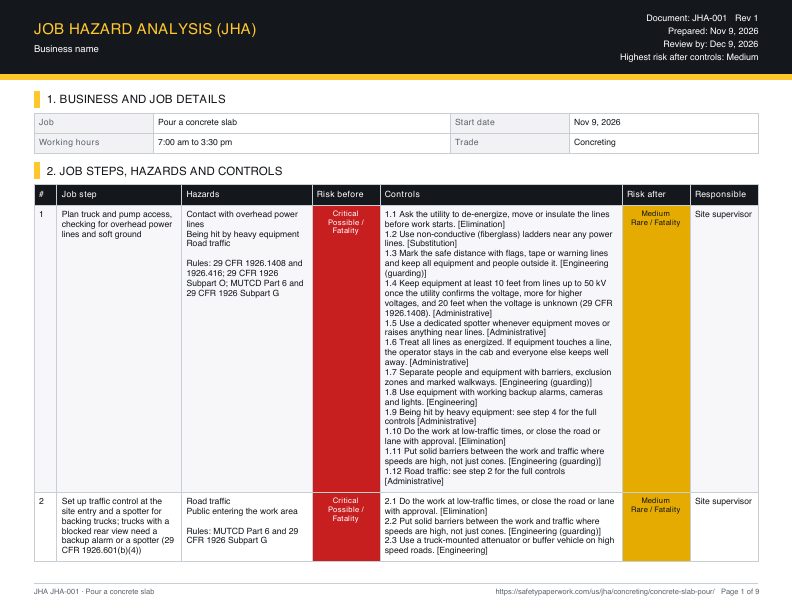
This is a complete JHA for concrete slab pour, with 9 job steps. Open it in the builder to add your site, crew and signatures, change anything, and download a PDF. Or download the free Word template below and fill it in by hand.
Job steps, hazards and controls
| # | Job step | Hazards | Risk before | Controls | Risk after |
|---|---|---|---|---|---|
| 1 | Plan truck and pump access, checking for overhead power lines and soft ground |
| Critical |
| Medium |
| 2 | Set up traffic control at the site entry and a spotter for backing trucks; trucks with a blocked rear view need a backup alarm or a spotter (29 CFR 1926.601(b)(4)) |
| Critical |
| Medium |
| 3 | Check formwork, edge forms, rebar and impalement-rated caps or covers on vertical rebar before the pour |
| High |
| Medium |
| 4 | Set up the pump with outriggers on pads and an exclusion zone around the boom and hose. Never open a line or clear a blockage until the pressure is released |
| Critical |
| Medium |
| 5 | Place concrete, keeping clear of the hose end and wearing gloves and boots |
| High |
| Medium |
| 6 | Vibrate and screed, keeping cords out of wet concrete and plugged into GFCI-protected outlets |
| High |
| Medium |
| 7 | Finish the surface, taking breaks in heat and sun |
| High |
| Medium |
| 8 | Wash out the pump and trucks only in the set wash out area, away from drains |
| Medium |
| Low |
| 9 | Cut control joints with a saw that feeds water to the blade (29 CFR 1926.1153 Table 1). Outdoors a walk-behind saw needs no respirator; a handheld saw needs APF 10 after 4 hours a shift, and any saw used indoors needs APF 10 |
| Critical |
| Medium |
PPE
Plant and equipment
Emergency
Call 911. Add the nearest hospital, the assembly point and the first aid / cpr person for your site.
Sign-off
Supervisor and every worker sign to confirm they have read and understood this JHA.
Free JHA template for concrete slab pour
Word (.docx) and PDF, Letter landscape, no email needed. Fill in your site details, then print or send it.
Make yours in 2 minutes
Same document, filled in for your job. Answer a few yes or no questions, the crew signs on the phone, and you send the PDF.
Pre-start checklist for concrete slab pour
Tick these off before work starts. They come from the hazards, permits and equipment in this job.
- JHA read, explained and signed by everyone on the job
- Overhead lines identified and safe distances marked
- Water suppression or on-tool extraction fitted; respirators fit tested
- Exclusion zone and spotter set up for equipment and traffic
- Exclusion zone below the work and public kept out
- Weather checked: water, shade and rest breaks planned
- First aid / CPR person, first aid kit and emergency number (911) confirmed
- PPE checked and worn: safety-toe boots (ASTM F2413), high-visibility safety apparel, ANSI/ISEA 107 class 2 or 3 (type r near roadways), chemical-resistant gloves, safety glasses (ANSI Z87.1)
The safe sequence of work
- Plan truck and pump access, checking for overhead power lines and soft ground
- Set up traffic control at the site entry and a spotter for backing trucks; trucks with a blocked rear view need a backup alarm or a spotter (29 CFR 1926.601(b)(4))
- Check formwork, edge forms, rebar and impalement-rated caps or covers on vertical rebar before the pour
- Set up the pump with outriggers on pads and an exclusion zone around the boom and hose. Never open a line or clear a blockage until the pressure is released
- Place concrete, keeping clear of the hose end and wearing gloves and boots
- Vibrate and screed, keeping cords out of wet concrete and plugged into GFCI-protected outlets
- Finish the surface, taking breaks in heat and sun
- Wash out the pump and trucks only in the set wash out area, away from drains
- Cut control joints with a saw that feeds water to the blade (29 CFR 1926.1153 Table 1). Outdoors a walk-behind saw needs no respirator; a handheld saw needs APF 10 after 4 hours a shift, and any saw used indoors needs APF 10
Hazards to watch on concrete slab pour
The hazards most specific to this job, and the step where each one comes up.
What changes on your site
This example covers the job itself. Your site may add more. Add controls for any of these that apply (the builder asks you these as yes or no questions):
- Will anyone work 6 feet or more above a lower level?
- Will anyone use a ladder or stepladder?
- Will anyone work on a roof?
- Is there a skylight, fiberglass panel or other fragile roofing?
- Will you use a scaffold or rolling tower?
Why JHAs get rejected
General contractors send documents back for these reasons. This example avoids them, but check yours too.
- Generic steps such as "work safely" or "use PPE" with no task-specific hazards or controls.
- No OSHA standards referenced for the hazards that have them, such as fall protection, ladders, scaffolds or silica.
- No competent person named for fall protection, excavation, scaffolds or silica where those hazards exist.
- Equipment listed without inspection requirements, and no training listed for the people using it.
- Respirators listed with no respiratory protection program, medical clearance or fit test.
- Controls rely only on PPE when engineering controls such as guardrails, wet cutting or extraction are feasible.
- No crew sign-off, or no date and revision when the job has changed.
Questions
Do I need a JHA for concrete slab pour?
OSHA expects employers to find and control hazards on every job, and many general contractors require a written JHA for concrete slab pour before you start.
Who signs the JHA?
The supervisor or competent person who prepared it signs, and every crew member signs to show they were trained on the hazards and controls before the job starts. Many general contractors also sign to accept it.
How long do I keep it?
Keep this JHA on site during the job, and keep it with the training and inspection records for at least 1 year after the job (longer if your state plan or general contractor requires it). OSHA does not set a retention period for JHAs themselves.
What PPE is needed for concrete slab pour?
Usually Safety-toe boots (ASTM F2413), High-visibility safety apparel, ANSI/ISEA 107 Class 2 or 3 (Type R near roadways), Chemical-resistant gloves, Safety glasses (ANSI Z87.1), Sun protection (sunscreen, hat, long sleeves), Hard hat (ANSI Z89.1), Work gloves, Safety goggles (ANSI Z87.1), Knee pads, Hearing protection (earmuffs or plugs), Half-face respirator (P100 cartridges), N95 respirator. The site rules may add more, so check with the general contractor.
More concreting JHAs
Related jobs in other trades
Toolbox talks for this job
Blank JHA template: free JHA templates. Also for other countries: Australia (SWMS) · United Kingdom (RAMS) · Canada (FLHA)