SafetyPaperwork
Concreting · Australia

SWMS for concrete slab pour

Yes. Concrete slab pour usually includes high risk construction work (work in an area with movement of powered mobile plant), so a SWMS is required by law before work starts.

It must list the hazards, the controls and how they will be put in place, monitored and reviewed, and the workers must be consulted and sign before starting. The main hazards are silica dust from concrete, brick, stone and tiles, being hit by mobile plant, road traffic and public entering the work area.

SWMS example: concrete slab pour

This is a complete SWMS for concrete slab pour, with 9 job steps. Open it in the builder to add your site, crew and signatures, change anything, and download a PDF. Or download the free Word template below and fill it in by hand.

Safe Work Method Statement (SWMS)
Pour a concrete slab · Concreting · Example
Document SWMS-001 · Rev 1

High risk construction work covered

Work in an area with movement of powered mobile plant

Job steps, hazards and controls

#Job stepHazardsRisk beforeControlsRisk after
1Plan truck and pump access, checking for overhead power lines and soft ground
  • Contact with overhead power lines
  • Being hit by mobile plant
  • Road traffic
Extreme
  • Ask the network operator to turn off, move or insulate the lines before work starts. Eliminate
  • Use non-conductive (fibreglass) ladders near any power lines. Substitute
  • Contact with overhead power lines: see step 4 for the full controls Administrative
  • Separate people and plant with barriers, exclusion zones and marked walkways. Isolate
  • Use plant with working reversing alarms, cameras and lights. Engineering
  • Being hit by mobile plant: see step 4 for the full controls Administrative
  • Do the work at low-traffic times, or close the road or lane with approval. Eliminate
  • Put solid barriers between the work and traffic where speeds are high, not just cones. Isolate
  • Use a truck-mounted attenuator or buffer vehicle on high speed roads. Engineering
  • Have a Traffic Management Plan. Signs and cones are set out by accredited traffic controllers to your state's rules. Administrative
  • Get a road occupancy or street works permit from the road authority before you start. Administrative
Medium
2Set up traffic control at the site entry and a spotter for reversing trucks
  • Road traffic
  • Public entering the work area
Extreme
  • Park work vehicles to shield the work zone, with beacons on. Administrative
  • Wear day and night hi-vis clothing (AS/NZS 4602.1). PPE
  • Road traffic: see step 1 for the full controls Administrative
  • Fence off the site with secure temporary fencing and lock the gates when you leave. Isolate
  • Give pedestrians a safe, marked path around the work, with ramps for prams and wheelchairs. Isolate
  • Use hoarding, covered walkways or catch fans where work is above public areas. Engineering
  • Put signs at each entry: site name, contact number and "No unauthorised entry". Administrative
  • Make the site safe at the end of each day: cover holes, lower plant, remove ladders and lock tools away. Administrative
  • Use a spotter when moving plant or materials across public paths. Administrative
Medium
3Check formwork, edge forms, reo and caps on starter bars before the pour
  • Formwork collapse
  • Impalement on reo bars
High
  • Keep people out from under the formwork during the pour. Isolate
  • Use formwork designed by a competent person or engineer for the load. Engineering
  • A competent person inspects the formwork and props before the pour and signs it off. Administrative
  • Follow the design for prop spacing, bracing and pour rate. Administrative
  • Watch for movement or bulging during the pour and stop if it happens. Administrative
  • Do not strip formwork until the concrete reaches the strength the engineer requires. Administrative
  • Wear a hard hat, safety boots and gloves. PPE
  • Cover or cap all exposed bar ends with approved caps or covers. Engineering
  • Bend bars over where the design allows. Engineering
  • Use edge protection near starter bars so nobody can fall onto them. Engineering
  • Keep walkways clear of exposed bars and mark the hazard. Administrative
  • Wear gloves, safety glasses and safety boots when handling bar. PPE
Medium
4Set up the pump with outriggers on pads and an exclusion zone around the boom and hose. Never open a line or clear a blockage until the pressure is released
  • Being hit by mobile plant
  • Contact with overhead power lines
Extreme
  • Separate people and plant with barriers, exclusion zones and marked walkways. Isolate
  • Use plant with working reversing alarms, cameras and lights. Engineering
  • Have a traffic management plan showing plant routes, loading areas and pedestrian paths. Administrative
  • Use a spotter when reversing or working near people. Administrative
  • Make eye contact with the operator before going near. Stay out of the swing radius. Administrative
  • Operators hold a High Risk Work Licence where needed (for example forklift) and are trained and assessed on other plant. Administrative
  • Do a pre-start check on each machine every day and record it. Administrative
  • Wear hi-vis clothing and a hard hat. PPE
  • Ask the network operator to turn off, move or insulate the lines before work starts. Eliminate
  • Use non-conductive (fibreglass) ladders near any power lines. Substitute
  • Mark the safe distance with flags, tape or goal posts and keep all plant and people outside it. Isolate
  • Keep out of the No Go Zone set by your state and the network operator, or get written approval and a safety observer. In NSW and Qld, untrained people and plant stay at least 3 m from lines on poles up to 132 kV, 6 m up to 330 kV and 8 m above 330 kV. In Victoria the limits differ, and work within 8 m of tower lines needs a spotter and the network operator's permission. Administrative
  • Use a dedicated spotter whenever plant moves or raises anything near lines. Administrative
  • Treat all lines as live. If plant touches a line, stay in the cab and keep everyone well away. Administrative
Medium
5Place concrete, keeping clear of the hose end and wearing gloves and boots
  • Wet concrete and cement burns
  • Lifting and carrying heavy loads
  • Slips and trips
High
  • Use long-handled tools and pumps to cut down contact. Engineering
  • Wash concrete off skin straight away with clean water. Administrative
  • Have clean water and eye wash at the pour. Administrative
  • Wear waterproof gloves, long sleeves and gumboots with trousers worn over the top. PPE
  • Wear safety glasses or goggles to stop splashes. PPE
  • Plan to avoid carrying: have materials delivered, and old items picked up, as close as possible to where they are used. Eliminate
  • Use lighter or smaller loads: order smaller bags and shorter lengths, and drain or break down old items before moving them. Substitute
  • Use trolleys, pallet jacks, hoists, vacuum lifters or plant instead of carrying by hand. Engineering
  • Use a two-person lift for anything heavy, long or awkward. Plan the route first and clear it. Administrative
  • Keep the load close, back straight and no twisting. Turn with your feet. Administrative
  • Plan walkways and keep them clear of materials, hoses and leads. Eliminate
  • Run leads and hoses overhead on hooks or stands, or along walls, not across walkways. Engineering
  • Fill or cover holes, and lay boards or mats on muddy access paths. Engineering
  • Clean up offcuts, packaging and spills as you go, not at the end of the day. Administrative
  • Keep work areas, stairs and access paths well lit. Administrative
Medium
6Vibrate and screed, keeping power leads out of wet concrete
  • Hand-arm and whole-body vibration
  • Electric shock from leads and power tools
  • Repetitive work and awkward postures
High
  • Use low-vibration tools and methods, such as a breaker on an excavator instead of a hand jackhammer. Substitute
  • Keep tools sharp and well maintained, and use anti-vibration handles and seats. Engineering
  • Limit trigger time on high-vibration tools and rotate workers. Administrative
  • Keep hands warm and dry, and take regular breaks. Administrative
  • Report tingling, numbness or white fingers early. Administrative
  • Use battery-powered tools where you can. Substitute
  • Plug all tools into an RCD-protected outlet or a portable RCD. Engineering
  • Keep leads off the ground and out of water, using lead stands or hooks. Engineering
  • Check leads, plugs and tools before every use. Tag out and remove anything damaged. Administrative
  • Test and tag leads, tools and RCDs at the intervals in AS/NZS 3012 (every 3 months on construction sites). Push-button test portable RCDs before each use. Administrative
  • Do not use tools in rain or wet areas unless they are rated for it. Administrative
  • Use tools that cut the effort: powered screwdrivers, long-handled tools and extension poles for overhead work. Substitute
  • Set work up at waist height on benches or trestles where you can. Engineering
  • Repetitive work and awkward postures: see step 7 for the full controls Administrative
Medium
7Finish the surface, taking breaks in heat and sun
  • Heat stress
  • Sun exposure (UV)
  • Repetitive work and awkward postures
High
  • Schedule heavy work for the cooler part of the day. Eliminate
  • Provide shade over work and rest areas, and fans or cooling in roof spaces. Engineering
  • Supply cool drinking water close by and drink a cup every 15 to 20 minutes. Administrative
  • Take regular rest breaks in the shade, more often as it gets hotter. Administrative
  • Let new and returning workers build up to full work in the heat over about a week. Administrative
  • Plan outdoor work for early morning or late afternoon when UV is lower. Eliminate
  • Put shade covers over fixed work areas. Engineering
  • Check the UV index each day. Use sun protection when it is 3 or higher. Administrative
  • Check your skin regularly and see a doctor about any new or changing spots. Administrative
  • Wear a broad-brim hat or hard hat brim, long sleeves, sunglasses and SPF 50+ sunscreen, reapplied every 2 hours. PPE
  • Use tools that cut the effort: powered screwdrivers, long-handled tools and extension poles for overhead work. Substitute
  • Set work up at waist height on benches or trestles where you can. Engineering
  • Use light tools with good grips, and keep blades and bits sharp. Engineering
  • Rotate tasks and take short breaks every hour on repetitive work. Administrative
  • Warm up before heavy physical work and report aches and pains early. Administrative
Medium
8Wash out the pump and trucks only in the set wash out area, away from drains
  • Wet concrete and cement burns
  • Poor housekeeping and waste
Medium
  • Wet concrete and cement burns: see step 5 for the full controls Administrative
  • Order materials to size and send packaging back where you can. Eliminate
  • Put skip bins and waste chutes close to the work. Engineering
  • Clean as you go, and do a full clean up at the end of each day. Administrative
  • Keep exits, stairs and walkways clear at all times. Administrative
  • Stack materials neatly on level ground, away from edges. Administrative
  • Wear gloves when handling waste. PPE
Low
9Cut control joints the next day with water suppression
  • Silica dust from concrete, brick, stone and tiles
  • Saw cuts and kickback
  • Loud noise
Extreme
  • If the job involves engineered stone: do not supply, fabricate or install engineered stone benchtops, panels or slabs (banned since 1 July 2024). Removing, repairing or making minor changes to existing engineered stone is only allowed with water suppression or on-tool extraction, a fitted respirator, and written notice to the regulator before the work starts. Eliminate
  • Order materials cut to size, or use low-dust methods such as score and snap or a block splitter. Substitute
  • Cut outdoors or in a separate area, with other people well away and upwind. Isolate
  • Use water on the blade or on-tool dust extraction connected to an H-class vacuum. Engineering
  • Clean up with a vacuum or wet methods. Never dry sweep or use compressed air. Administrative
  • If the cutting, grinding or drilling is high risk, prepare a silica risk control plan (or include the r.529CA assessment in this SWMS), train workers in silica risks and give them the plan before work starts. Administrative
  • Wear a fit-tested P2 (or better) respirator. PPE
  • Keep blade guards fitted and working, and use the riving knife on table saws. Engineering
  • Use push sticks and clamps, and support long pieces so they do not pinch the blade. Engineering
  • Use a sharp, undamaged blade made for the material. Administrative
  • Stand to one side of the blade line, out of the kickback path. Administrative
  • Let the blade stop fully before reaching in or putting the saw down. Administrative
  • Use quieter tools and methods, such as cut-to-size materials, low-noise machines and battery tools. Substitute
  • Keep noisy plant away from work areas, and use screens or distance between the noise and people. Isolate
  • Keep tools maintained and use mufflers on compressors and generators. Engineering
  • Limit time on noisy tools and rotate workers. Administrative
  • If you have to shout to be heard 1 metre away, wear hearing protection. Administrative
  • Keep exposure below 85 dB(A) over 8 hours. Give hearing tests to workers who often need hearing protection. Administrative
Medium

PPE

Steel cap bootsHi-vis shirt or vestChemical-resistant gloves (nitrile)Safety glassesSun protection (brim hat, long sleeves, SPF 50+)Hard hatWork glovesSafety gogglesKnee padsHearing protection (earmuffs or plugs)Half-face respirator (P2 or P3 filters)P2 dust mask

Plant and equipment

Concrete pump (boom or line): High Risk Work Licence PB for truck-mounted concrete placing booms (not needed for line pumps)Wacker plateHand toolsConcrete saw

Emergency

Call 000. Add the nearest hospital, the assembly point and the first aider for your site.

Sign-off

Supervisor and every worker sign to confirm they have read and understood this SWMS.
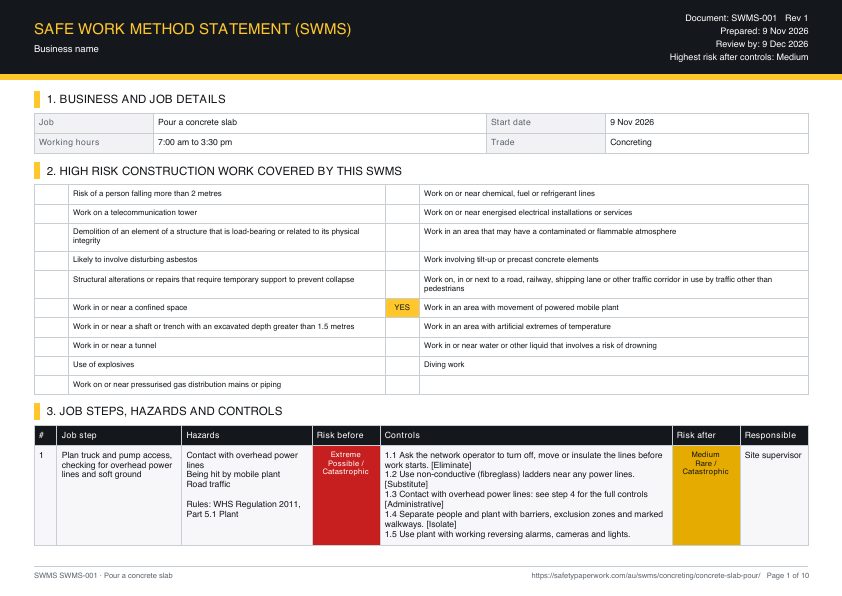
Page 1 of the free concrete slab pour SWMS template: business details, high risk construction work and job steps with hazards, risk ratings and controls

Free SWMS template for concrete slab pour

Word (.docx) and PDF, A4 landscape, no email needed. Fill in your site details, then print or send it.

Make yours in 2 minutes

Same document, filled in for your job. Answer a few yes or no questions, the crew signs on the phone, and you send the PDF.

Start this SWMS

Pre-start checklist for concrete slab pour

Tick these off before work starts. They come from the hazards, permits and equipment in this job.

The safe sequence of work

  1. Plan truck and pump access, checking for overhead power lines and soft ground
  2. Set up traffic control at the site entry and a spotter for reversing trucks
  3. Check formwork, edge forms, reo and caps on starter bars before the pour
  4. Set up the pump with outriggers on pads and an exclusion zone around the boom and hose. Never open a line or clear a blockage until the pressure is released
  5. Place concrete, keeping clear of the hose end and wearing gloves and boots
  6. Vibrate and screed, keeping power leads out of wet concrete
  7. Finish the surface, taking breaks in heat and sun
  8. Wash out the pump and trucks only in the set wash out area, away from drains
  9. Cut control joints the next day with water suppression

Hazards to watch on concrete slab pour

The hazards most specific to this job, and the step where each one comes up.

Step 3Formwork collapseFormwork or falsework fails during a concrete pour and collapses with workers on or under it.
Step 3Impalement on reo barsA worker falls or trips onto exposed reo or starter bars and is impaled or badly cut.
Step 1, 2Road trafficPassing cars and trucks hit workers or plant working on or next to a road.
Step 7Sun exposure (UV)Long hours in the sun cause sunburn, eye damage and skin cancer.
Step 1, 4Contact with overhead power linesA ladder, EWP, crane, tipper or long length of material touches or gets close to an overhead line and electrocutes people.
Step 5, 8Wet concrete and cement burnsWet concrete, mortar and cement burn skin and eyes. Burns can be deep and are often not felt until later.
Almost certainLikelyPossibleUnlikelyRareHow bad it could be: Insignificant to CatastrophicBA
Highest risk on concrete slab pour: Extreme before controls (B), down to Medium after controls (A), on the Australia 5 by 5 risk matrix (likely and catastrophic becomes unlikely and major).

What changes on your site

This example covers the job itself. Your site may add more. Add controls for any of these that apply (the builder asks you these as yes or no questions):

  • Will anyone work more than 2 metres off the ground?
  • Will anyone use a ladder or stepladder?
  • Will anyone work on a roof?
  • Is there a skylight, clear sheet, fibro or other fragile roofing?
  • Will you use a scaffold or mobile tower?

Licences and legal requirements in Australia

This task can involve these high risk construction work categories under the WHS Regulations:

  • Work in an area with movement of powered mobile plant

Equipment on this job that needs a licence, ticket or training:

  • Concrete pump (boom or line): High Risk Work Licence PB for truck-mounted concrete placing booms (not needed for line pumps)

A SWMS must be prepared before any high risk construction work starts. It must list the high risk work, the hazards and risks, the control measures, and how those controls will be put in place, monitored and reviewed. It must be easy for the workers to read and understand.

Rules that apply: WHS Regulation 2011, Part 5.1 Plant; WHS Regulation 2011, Part 4.2 Hazardous manual tasks; WHS Regulation 2011, Part 4.7 and AS/NZS 3012; WHS Regulations, Chapter 8A (Crystalline silica substances and engineered stone); WHS Regulation 2011, Part 4.1 Noise.

Each state has its own regulator and some extra rules: New South Wales, Victoria, Queensland, Western Australia, South Australia and Australian Capital Territory.

Why SWMS get rejected

Principal contractors send documents back for these reasons. This example avoids them, but check yours too.

  • It is generic: another site address, tasks that are not on this job, or no sign it was reviewed for this site. WorkSafe WA says a generic SWMS may not meet the regulations unless it is reviewed and amended for the workplace.
  • The HRCW boxes are not ticked, or the ticks do not match the tasks (for example a roof job with no falls box ticked).
  • Falls are controlled only by "be careful", training or a harness, with no edge protection or scaffold and no reason why higher controls are not reasonably practicable.
  • Workers will clip on to a harness but there is no rescue plan for someone left hanging.
  • The "how controls are implemented, monitored and reviewed" part is missing, or it says the same thing on every row.
  • No worker sign-on, no person responsible for compliance, or a date given to the principal contractor that is before they actually received it.
  • Licence or White Card details are missing for workers operating plant or doing licensed high risk work.

Questions

Do I need a SWMS for concrete slab pour?

Yes. Concrete slab pour usually includes high risk construction work (work in an area with movement of powered mobile plant), so a SWMS is required by law before work starts.

Who signs the SWMS?

The person conducting the business (PCBU) or their supervisor prepares it with the workers, and every worker doing the high risk work signs to show they were consulted and understand it. Give a copy to the principal contractor before work starts.

How long do I keep it?

Keep this SWMS, and every revised version, until the high risk construction work is finished, where workers and inspectors can see it on site. If a notifiable incident happens during the work, keep it for at least 2 years after the incident.

What PPE is needed for concrete slab pour?

Usually Steel cap boots, Hi-vis shirt or vest, Chemical-resistant gloves (nitrile), Safety glasses, Sun protection (brim hat, long sleeves, SPF 50+), Hard hat, Work gloves, Safety goggles, Knee pads, Hearing protection (earmuffs or plugs), Half-face respirator (P2 or P3 filters), P2 dust mask. The site rules may add more, so check with the principal contractor.

More concreting SWMS

Related jobs in other trades

Toolbox talks for this job

Blank SWMS template: free SWMS templates. Also for other countries: United Kingdom (RAMS) · United States (JHA) · Canada (FLHA)

Sources