SafetyPaperwork
Scaffolding · United States

JHA for scaffold erection

OSHA expects employers to find and control hazards on every job, and many general contractors require a written JHA for scaffold erection before you start.

A JHA breaks the job into steps, lists the hazards in each step and the controls that protect the crew, and the crew signs it. The main hazards are falling from height, scaffold collapse or fall from scaffold, road traffic and public entering the work area.

JHA example: scaffold erection

This is a complete JHA for scaffold erection, with 9 job steps. Open it in the builder to add your site, crew and signatures, change anything, and download a PDF. Or download the free Word template below and fill it in by hand.

Job Hazard Analysis (JHA)
Scaffold erection · Scaffolding · Example
Document JHA-001 · Rev 1

Job steps, hazards and controls

#Job stepHazardsRisk beforeControlsRisk after
1Check the design, ground conditions and power lines before unloading. Keep the scaffold and anything handled on it at least 10 feet from power lines up to 50 kV (3 feet from insulated lines under 300 volts) (29 CFR 1926.451(f)(6))
  • Contact with overhead power lines
  • Scaffold collapse or fall from scaffold
Critical
  • Ask the utility to de-energize, move or insulate the lines before work starts. Elimination
  • Use non-conductive (fiberglass) ladders near any power lines. Substitution
  • Mark the safe distance with flags, tape or warning lines and keep all equipment and people outside it. Engineering (guarding)
  • Keep equipment at least 10 feet from lines up to 50 kV once the utility confirms the voltage, more for higher voltages, and 20 feet when the voltage is unknown (29 CFR 1926.1408). Administrative
  • Use a dedicated spotter whenever equipment moves or raises anything near lines. Administrative
  • Treat all lines as energized. If equipment touches a line, the operator stays in the cab and everyone else keeps well away. Administrative
  • Scaffold is built, moved and taken down under the supervision of a competent person. Engineering
  • Fit guardrails, mid rails and toe boards on every platform more than 10 feet above a lower level, or use personal fall arrest (29 CFR 1926.451(g)(1)). Engineering
  • Scaffold collapse or fall from scaffold: see step 9 for the full controls Administrative
Medium
2Set up an exclusion zone or hoarding and control traffic and the public
  • Public entering the work area
  • Road traffic
  • Falling tools and materials
Critical
  • Fence off the site with secure temporary fencing and lock the gates when you leave. Engineering (guarding)
  • Give pedestrians a safe, marked path around the work, with ramps for strollers and wheelchairs. Engineering (guarding)
  • Use hoarding, covered walkways or catch fans where work is above public areas. Engineering
  • Put signs at each entry: site name, contact number and "No unauthorized entry". Administrative
  • Make the site safe at the end of each day: cover holes, lower plant, remove ladders and lock tools away. Administrative
  • Do the work at low-traffic times, or close the road or lane with approval. Elimination
  • Put solid barriers between the work and traffic where speeds are high, not just cones. Engineering (guarding)
  • Road traffic: see step 3 for the full controls Administrative
  • Barricade and sign the drop zone under overhead work so nobody walks beneath. Engineering (guarding)
  • Fit toe boards, kick plates and mesh screens on scaffolds and edges. Engineering
  • Falling tools and materials: see step 6 for the full controls Administrative
Medium
3Unload and stack gear close to the work, lifting with a partner
  • Lifting and carrying heavy loads
  • Road traffic
Critical
  • Plan to avoid carrying: have materials delivered, and old items picked up, as close as possible to where they are used. Elimination
  • Use lighter or smaller loads: order smaller bags and shorter lengths, and drain or break down old items before moving them. Substitution
  • Use trolleys, pallet jacks, hoists, vacuum lifters or plant instead of carrying by hand. Engineering
  • Use a two-person lift for anything heavy, long or awkward. Plan the route first and clear it. Administrative
  • Keep the load close, back straight and no twisting. Turn with your feet. Administrative
  • Rotate tasks and take breaks on long lifting jobs. Administrative
  • Wear gloves for grip and safety boots to protect your feet. PPE
  • Do the work at low-traffic times, or close the road or lane with approval. Elimination
  • Put solid barriers between the work and traffic where speeds are high, not just cones. Engineering (guarding)
  • Use a truck-mounted attenuator or buffer vehicle on high speed roads. Engineering
  • Set up work zone signs and cones to MUTCD Part 6, with trained flaggers. Administrative
  • Get any permit needed from the city, county or state DOT before you start. Administrative
  • Park work vehicles to shield the work zone, with beacons on. Administrative
  • Wear ANSI/ISEA 107 Class 2 or 3 high-visibility clothing. PPE
Medium
4Set base plates and mudsills on firm, level ground (29 CFR 1926.451(c)(2))
  • Scaffold collapse or fall from scaffold
Critical
  • Use mobile scaffolds only on firm, level ground with casters locked, and guy, tie, brace or fit outriggers once the height is more than 4 times the base width (29 CFR 1926.451(c)(1)). Never move one with anyone on it. Engineering
  • Every worker on the scaffold is trained by a qualified person (29 CFR 1926.454). Administrative
  • Scaffold collapse or fall from scaffold: see step 9 for the full controls Administrative
Medium
5Erect level by level, installing guardrails as you go. The competent person decides where fall protection for erectors is feasible, and it is used there (29 CFR 1926.451(g)(2))
  • Falling from height
  • Scaffold collapse or fall from scaffold
Critical
  • Do the work from the ground where you can, for example pre-assemble on the ground or use extension poles. Elimination
  • Install guardrails or edge protection on all open edges before work starts. Engineering (guarding)
  • Use a scaffold, mobile work platform or aerial lift instead of working off a ladder. Engineering
  • Where edge protection is not practical, use a fall restraint or fall arrest system on a rated anchor point. Engineering
  • Provide fall protection at 6 feet or more and train workers to recognize fall hazards (29 CFR 1926.503). Administrative
  • Have a rescue plan so a worker hanging in a harness can be brought down within minutes. Administrative
  • Wear a full body harness with a shock-absorbing lanyard, clipped on at all times when using fall arrest. PPE
  • A competent person inspects the scaffold before each shift and after anything that could affect it (29 CFR 1926.451(f)(3)). Administrative
  • Do not overload platforms. Know the rated load (light, medium or heavy duty) and stack materials over the legs, not mid-span (29 CFR 1926.451(f)(1)). Administrative
  • Scaffold collapse or fall from scaffold: see step 9 for the full controls Administrative
Medium
6Pass components up by hand or with a rated gin wheel fixed to the maker's instructions, never throw them
  • Falling tools and materials
  • Lifting and carrying heavy loads
High
  • Barricade and sign the drop zone under overhead work so nobody walks beneath. Engineering (guarding)
  • Fit toe boards, kick plates and mesh screens on scaffolds and edges. Engineering
  • Use catch fans, debris netting or covered walkways where people pass below. Engineering
  • Tether hand tools when working at height. Engineering
  • Keep platforms tidy. Do not stack materials near edges or above toe board height. Administrative
  • Lower materials with a hoist, chute or rope. Never throw or drop anything down. Administrative
  • Wear a hard hat anywhere objects could fall. PPE
  • Lifting and carrying heavy loads: see step 3 for the full controls Administrative
Medium
7Tie in to the building as each level goes up, to the manufacturer or design spacing: no farther apart than 20 feet vertically (26 feet for scaffolds wider than 3 feet) and 30 feet horizontally (29 CFR 1926.451(c)(1))
  • Scaffold collapse or fall from scaffold
  • Strong wind and storms
Critical
  • Never remove ties, braces, guardrails or planks. Only the erection crew alters the scaffold, under the direction of the competent person (29 CFR 1926.451(f)(7)). Administrative
  • Wear a hard hat and safety boots on and around the scaffold. PPE
  • Scaffold collapse or fall from scaffold: see step 9 for the full controls Administrative
  • Check the forecast each morning and plan work at height and lifting around the weather. Elimination
  • Tie down or weigh down loose sheets, panels, boards and rubbish at the end of each shift. Engineering
  • Set wind limits for roof work, platforms and cranes, using the manufacturer's limits, and stop when they are reached. Administrative
  • Stop work and get down in lightning. Wait 30 minutes after the last thunder before going back up. Administrative
  • Check scaffold, fencing and edge protection after strong wind before anyone uses them. Administrative
  • Do not carry large sheets on roofs in wind. Administrative
  • Wear a hard hat with a chin strap at height in windy conditions. PPE
Medium
8Fit decks, guardrails, toe boards and ladder access
  • Falling from height
  • Falling tools and materials
  • Falling from a ladder
Critical
  • Falling from height: see step 5 for the full controls Administrative
  • Falling tools and materials: see step 6 for the full controls Administrative
  • Use a platform ladder, mobile scaffold or aerial lift for longer jobs instead of a straight ladder. Substitution
  • Use Type I, IA or IAA ladders in good condition. Tag and remove any damaged ladder. Engineering
  • Set extension ladders at a 4 to 1 angle on firm, level ground, secured, and reaching 3 feet above the landing. Engineering
  • Use ladders only for short, light work. Do not carry heavy or awkward loads up a ladder. Administrative
  • Keep three points of contact and your belt buckle between the stiles. Do not overreach. Administrative
Medium
9Competent person inspects the scaffold before first use and before each shift, and tags it (29 CFR 1926.451(f)(3))
  • Scaffold collapse or fall from scaffold
Critical
  • Scaffold is built, moved and taken down under the supervision of a competent person. Engineering
  • Fit guardrails, mid rails and toe boards on every platform more than 10 feet above a lower level, or use personal fall arrest (29 CFR 1926.451(g)(1)). Engineering
  • Use mobile scaffolds only on firm, level ground with casters locked, and guy, tie, brace or fit outriggers once the height is more than 4 times the base width (29 CFR 1926.451(c)(1)). Never move one with anyone on it. Engineering
  • Every worker on the scaffold is trained by a qualified person (29 CFR 1926.454). Administrative
  • A competent person inspects the scaffold before each shift and after anything that could affect it (29 CFR 1926.451(f)(3)). Administrative
  • Do not overload platforms. Know the rated load (light, medium or heavy duty) and stack materials over the legs, not mid-span (29 CFR 1926.451(f)(1)). Administrative
  • Never remove ties, braces, guardrails or planks. Only the erection crew alters the scaffold, under the direction of the competent person (29 CFR 1926.451(f)(7)). Administrative
  • Wear a hard hat and safety boots on and around the scaffold. PPE
Medium

PPE

Safety-toe boots (ASTM F2413)Hard hat (ANSI Z89.1)Personal fall arrest system (harness)Work glovesHigh-visibility safety apparel, ANSI/ISEA 107 Class 2 or 3 (Type R near roadways)Safety glasses (ANSI Z87.1)

Plant and equipment

Supported scaffold: Erected under a competent person (29 CFR 1926.451)TrailerHand tools

Permits and plans

Written fall protection plan (only where guardrails, nets or personal fall arrest are not feasible, 1926.502(k))

Emergency

Call 911. Add the nearest hospital, the assembly point and the first aid / cpr person for your site.

Sign-off

Supervisor and every worker sign to confirm they have read and understood this JHA.
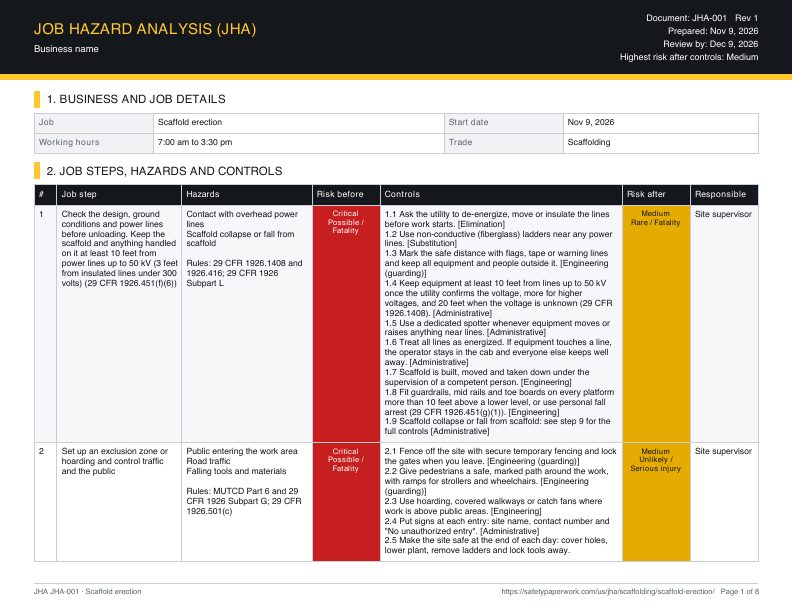
Page 1 of the free scaffold erection JHA template: business details, job steps with hazards, risk ratings and controls

Free JHA template for scaffold erection

Word (.docx) and PDF, Letter landscape, no email needed. Fill in your site details, then print or send it.

Make yours in 2 minutes

Same document, filled in for your job. Answer a few yes or no questions, the crew signs on the phone, and you send the PDF.

Start this JHA

Pre-start checklist for scaffold erection

Tick these off before work starts. They come from the hazards, permits and equipment in this job.

The safe sequence of work

  1. Check the design, ground conditions and power lines before unloading. Keep the scaffold and anything handled on it at least 10 feet from power lines up to 50 kV (3 feet from insulated lines under 300 volts) (29 CFR 1926.451(f)(6))
  2. Set up an exclusion zone or hoarding and control traffic and the public
  3. Unload and stack gear close to the work, lifting with a partner
  4. Set base plates and mudsills on firm, level ground (29 CFR 1926.451(c)(2))
  5. Erect level by level, installing guardrails as you go. The competent person decides where fall protection for erectors is feasible, and it is used there (29 CFR 1926.451(g)(2))
  6. Pass components up by hand or with a rated gin wheel fixed to the maker's instructions, never throw them
  7. Tie in to the building as each level goes up, to the manufacturer or design spacing: no farther apart than 20 feet vertically (26 feet for scaffolds wider than 3 feet) and 30 feet horizontally (29 CFR 1926.451(c)(1))
  8. Fit decks, guardrails, toe boards and ladder access
  9. Competent person inspects the scaffold before first use and before each shift, and tags it (29 CFR 1926.451(f)(3))

Hazards to watch on scaffold erection

The hazards most specific to this job, and the step where each one comes up.

Step 2, 3Road trafficPassing cars and trucks hit workers or plant working on or next to a road.
Step 1, 4, 5, 7, 9Scaffold collapse or fall from scaffoldA scaffold that is badly built, overloaded or altered collapses or tips, or a worker falls from an unguarded platform.
Step 1Contact with overhead power linesA ladder, aerial lift, crane, dump truck or long length of material touches or gets close to an overhead line and electrocutes people.
Step 7Strong wind and stormsWind blows sheets, panels and people off roofs and scaffolds, and storms and lightning make work at height and lifting unsafe.
Step 8Falling from a ladderThe ladder slips or tips, or the worker overreaches, and they fall onto a hard surface.
Step 5, 8Falling from heightA worker falls 6 feet or more from an edge, platform or opening to a lower level and is badly hurt or killed.
Almost certainLikelyPossibleUnlikelyRareHow bad it could be: First aid only to FatalityBA
Highest risk on scaffold erection: Critical before controls (B), down to Medium after controls (A), on the United States 5 by 5 risk matrix (likely and fatality becomes unlikely and serious injury).

What changes on your site

This example covers the job itself. Your site may add more. Add controls for any of these that apply (the builder asks you these as yes or no questions):

  • Will anyone work on a roof?
  • Is there a skylight, fiberglass panel or other fragile roofing?
  • Will you use an aerial lift (scissor lift or boom lift)?
  • Was the building built before 1981?
  • Is it a home or child-occupied facility (such as a child care center or preschool) built before 1978, and will you disturb paint?

Licences and legal requirements in United States

Equipment on this job that needs a licence, ticket or training:

  • Supported scaffold: Erected under a competent person (29 CFR 1926.451)

OSHA requires employers to find and fix hazards and to train workers on them. A JHA breaks the job into steps, lists the hazards in each step and the controls that protect the crew. General contractors often require one before you start.

Rules that apply: 29 CFR 1926.1408 and 1926.416; 29 CFR 1926 Subpart L; MUTCD Part 6 and 29 CFR 1926 Subpart G; 29 CFR 1926.501(c); 29 CFR 1926 Subpart M; 29 CFR 1926 Subpart X.

Why JHAs get rejected

General contractors send documents back for these reasons. This example avoids them, but check yours too.

  • Generic steps such as "work safely" or "use PPE" with no task-specific hazards or controls.
  • No OSHA standards referenced for the hazards that have them, such as fall protection, ladders, scaffolds or silica.
  • No competent person named for fall protection, excavation, scaffolds or silica where those hazards exist.
  • Equipment listed without inspection requirements, and no training listed for the people using it.
  • Respirators listed with no respiratory protection program, medical clearance or fit test.
  • Controls rely only on PPE when engineering controls such as guardrails, wet cutting or extraction are feasible.
  • No crew sign-off, or no date and revision when the job has changed.

Questions

Do I need a JHA for scaffold erection?

OSHA expects employers to find and control hazards on every job, and many general contractors require a written JHA for scaffold erection before you start.

Who signs the JHA?

The supervisor or competent person who prepared it signs, and every crew member signs to show they were trained on the hazards and controls before the job starts. Many general contractors also sign to accept it.

How long do I keep it?

Keep this JHA on site during the job, and keep it with the training and inspection records for at least 1 year after the job (longer if your state plan or general contractor requires it). OSHA does not set a retention period for JHAs themselves.

What PPE is needed for scaffold erection?

Usually Safety-toe boots (ASTM F2413), Hard hat (ANSI Z89.1), Personal fall arrest system (harness), Work gloves, High-visibility safety apparel, ANSI/ISEA 107 Class 2 or 3 (Type R near roadways), Safety glasses (ANSI Z87.1). The site rules may add more, so check with the general contractor.

More scaffolding JHAs

Related jobs in other trades

Toolbox talks for this job

Blank JHA template: free JHA templates. Also for other countries: Australia (SWMS) · United Kingdom (RAMS) · Canada (FLHA)

Sources