JHA for lead paint removal (RRP)
OSHA expects employers to find and control hazards on every job, and many general contractors require a written JHA for lead paint removal (RRP) before you start.
A JHA breaks the job into steps, lists the hazards in each step and the controls that protect the crew, and the crew signs it. The main hazards are fire from hot works, lead paint dust and fumes, public entering the work area and flammable liquids and gases.
JHA example: lead paint removal (RRP)
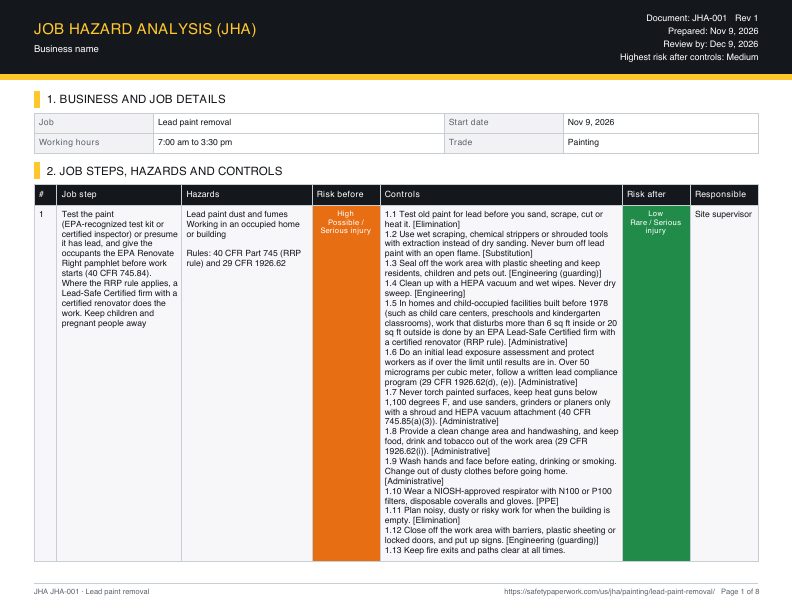
This is a complete JHA for lead paint removal (RRP), with 10 job steps. Open it in the builder to add your site, crew and signatures, change anything, and download a PDF. Or download the free Word template below and fill it in by hand.
Job steps, hazards and controls
| # | Job step | Hazards | Risk before | Controls | Risk after |
|---|---|---|---|---|---|
| 1 | Test the paint (EPA-recognized test kit or certified inspector) or presume it has lead, and give the occupants the EPA Renovate Right pamphlet before work starts (40 CFR 745.84). Where the RRP rule applies, a Lead-Safe Certified firm with a certified renovator does the work. Keep children and pregnant people away |
| High |
| Low |
| 2 | Turn off heating and cooling and close windows and vents in the work area |
| High |
| Low |
| 3 | Post warning signs and contain the area: indoors, close and cover ducts and cover the floor 6 feet past the work; outdoors, cover the ground 10 feet out and close doors and windows within 20 feet (40 CFR 745.85(a)(1), (2)) |
| High |
| Low |
| 4 | Put on coveralls and a fitted respirator, and set up a wash point |
| High |
| Medium |
| 5 | Mist and wet scrape the paint; no dry sanding or open flame |
| High |
| Medium |
| 6 | Use chemical strippers with ventilation and chemical gloves |
| High |
| Medium |
| 7 | Use a heat gun only below 1,100 degrees F, and never an open flame or torch (40 CFR 745.85(a)(3)) |
| Critical |
| Medium |
| 8 | Clean with a HEPA vacuum and wet wipes, never dry sweep |
| High |
| Low |
| 9 | Bag waste, remove coveralls in the work area and wash before eating |
| High |
| Low |
| 10 | Do the RRP cleaning verification before removing plastic and letting occupants back in |
| High |
| Low |
PPE
Plant and equipment
Permits and plans
Emergency
Call 911. Add the nearest hospital, the assembly point and the first aid / cpr person for your site.
Sign-off
Supervisor and every worker sign to confirm they have read and understood this JHA.
Free JHA template for lead paint removal (RRP)
Word (.docx) and PDF, Letter landscape, no email needed. Fill in your site details, then print or send it.
Make yours in 2 minutes
Same document, filled in for your job. Answer a few yes or no questions, the crew signs on the phone, and you send the PDF.
Pre-start checklist for lead paint removal (RRP)
Tick these off before work starts. They come from the hazards, permits and equipment in this job.
- JHA read, explained and signed by everyone on the job
- Hot work permit issued, extinguisher at hand, fire watch arranged
- Exclusion zone below the work and public kept out
- First aid / CPR person, first aid kit and emergency number (911) confirmed
- PPE checked and worn: safety glasses (ANSI Z87.1), half-face respirator (P100 cartridges), coveralls, chemical-resistant gloves
The safe sequence of work
- Test the paint (EPA-recognized test kit or certified inspector) or presume it has lead, and give the occupants the EPA Renovate Right pamphlet before work starts (40 CFR 745.84). Where the RRP rule applies, a Lead-Safe Certified firm with a certified renovator does the work. Keep children and pregnant people away
- Turn off heating and cooling and close windows and vents in the work area
- Post warning signs and contain the area: indoors, close and cover ducts and cover the floor 6 feet past the work; outdoors, cover the ground 10 feet out and close doors and windows within 20 feet (40 CFR 745.85(a)(1), (2))
- Put on coveralls and a fitted respirator, and set up a wash point
- Mist and wet scrape the paint; no dry sanding or open flame
- Use chemical strippers with ventilation and chemical gloves
- Use a heat gun only below 1,100 degrees F, and never an open flame or torch (40 CFR 745.85(a)(3))
- Clean with a HEPA vacuum and wet wipes, never dry sweep
- Bag waste, remove coveralls in the work area and wash before eating
- Do the RRP cleaning verification before removing plastic and letting occupants back in
Hazards to watch on lead paint removal (RRP)
The hazards most specific to this job, and the step where each one comes up.
What changes on your site
This example covers the job itself. Your site may add more. Add controls for any of these that apply (the builder asks you these as yes or no questions):
- Will anyone work 6 feet or more above a lower level?
- Will anyone use a ladder or stepladder?
- Will anyone work on a roof?
- Is there a skylight, fiberglass panel or other fragile roofing?
- Will you use a scaffold or rolling tower?
Why JHAs get rejected
General contractors send documents back for these reasons. This example avoids them, but check yours too.
- Generic steps such as "work safely" or "use PPE" with no task-specific hazards or controls.
- No OSHA standards referenced for the hazards that have them, such as fall protection, ladders, scaffolds or silica.
- No competent person named for fall protection, excavation, scaffolds or silica where those hazards exist.
- Equipment listed without inspection requirements, and no training listed for the people using it.
- Respirators listed with no respiratory protection program, medical clearance or fit test.
- Controls rely only on PPE when engineering controls such as guardrails, wet cutting or extraction are feasible.
- No crew sign-off, or no date and revision when the job has changed.
Questions
Do I need a JHA for lead paint removal (RRP)?
OSHA expects employers to find and control hazards on every job, and many general contractors require a written JHA for lead paint removal (RRP) before you start.
Who signs the JHA?
The supervisor or competent person who prepared it signs, and every crew member signs to show they were trained on the hazards and controls before the job starts. Many general contractors also sign to accept it.
How long do I keep it?
Keep this JHA on site during the job, and keep it with the training and inspection records for at least 1 year after the job (longer if your state plan or general contractor requires it). OSHA does not set a retention period for JHAs themselves.
What PPE is needed for lead paint removal (RRP)?
Usually Safety glasses (ANSI Z87.1), Half-face respirator (P100 cartridges), Coveralls, Chemical-resistant gloves, Safety-toe boots (ASTM F2413), Work gloves, N95 respirator, High-visibility safety apparel, ANSI/ISEA 107 Class 2 or 3 (Type R near roadways), Safety goggles (ANSI Z87.1), Welding gloves, Face shield (ANSI Z87.1). The site rules may add more, so check with the general contractor.
More painting JHAs
Related jobs in other trades
Toolbox talks for this job
Blank JHA template: free JHA templates. Also for other countries: Australia (SWMS) · United Kingdom (RAMS) · Canada (FLHA)