RAMS for scaffold erection
You must assess the risks of scaffold erection and record the significant findings if you employ 5 or more people. On CDM sites the principal contractor will ask for RAMS before you start.
RAMS cover the hazards, who could be harmed and how, the controls and the safe sequence of work, and the crew is briefed and signs. The main hazards are falling from height, scaffold collapse or fall from scaffold, road traffic and public entering the work area.
RAMS example: scaffold erection
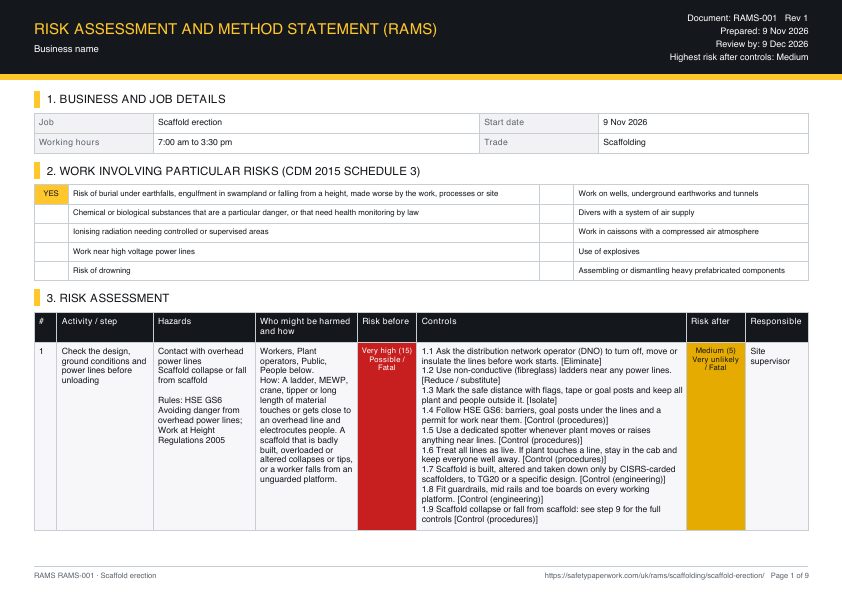
This is a complete RAMS for scaffold erection, with 9 job steps. Open it in the builder to add your site, crew and signatures, change anything, and download a PDF. Or download the free Word template below and fill it in by hand.
Risk assessment
| # | Activity | Hazards | Who might be harmed | Risk before | Controls | Risk after |
|---|---|---|---|---|---|---|
| 1 | Check the design, ground conditions and power lines before unloading |
| Workers, Plant operators, Public, People below | Very high (15) |
| Medium (5) |
| 2 | Set up an exclusion zone or hoarding and control traffic and the public. If the scaffold or hoarding is on the pavement or road, get a licence from the highway authority first (Highways Act 1980 s169 and s172) and light it at night |
| Public, Children, Workers, Road users, People below | Very high (15) |
| Medium (8) |
| 3 | Unload and stack gear close to the work, lifting with a partner |
| Workers, Road users, Public | Very high (15) |
| Medium (6) |
| 4 | Set base plates and sole boards on firm, level ground |
| Workers, Public, People below | Very high (15) |
| Medium (5) |
| 5 | Erect lift by lift to NASC SG4: fit advance guardrails before stepping onto each new lift, and clip a harness to a suitable anchor wherever collective protection is not yet in place |
| Workers, People below, Public | Very high (20) |
| Medium (5) |
| 6 | Pass components up by hand or with a rated gin wheel fixed to the maker's instructions, never throw them |
| Workers, Public, People below | High (12) |
| Medium (8) |
| 7 | Tie in to the building at the TG20 or design spacing as each lift goes up, and have anchor ties pull tested (NASC TG4) |
| Workers, Public, People below | Very high (15) |
| Medium (5) |
| 8 | Fit decks, guardrails, toe boards and ladder access |
| Workers, People below, Public | Very high (20) |
| Medium (8) |
| 9 | Inspect, tag and hand over the scaffold with a written handover certificate stating its load class and permitted use. Record the inspection, and re-inspect at least every 7 days and after alteration or bad weather (Work at Height Regulations 2005 reg 12 and Schedule 7) |
| Workers, Public, People below | Very high (15) |
| Medium (5) |
Method statement: sequence of work
- Check the design, ground conditions and power lines before unloading
- Set up an exclusion zone or hoarding and control traffic and the public. If the scaffold or hoarding is on the pavement or road, get a licence from the highway authority first (Highways Act 1980 s169 and s172) and light it at night
- Unload and stack gear close to the work, lifting with a partner
- Set base plates and sole boards on firm, level ground
- Erect lift by lift to NASC SG4: fit advance guardrails before stepping onto each new lift, and clip a harness to a suitable anchor wherever collective protection is not yet in place
- Pass components up by hand or with a rated gin wheel fixed to the maker's instructions, never throw them
- Tie in to the building at the TG20 or design spacing as each lift goes up, and have anchor ties pull tested (NASC TG4)
- Fit decks, guardrails, toe boards and ladder access
- Inspect, tag and hand over the scaffold with a written handover certificate stating its load class and permitted use. Record the inspection, and re-inspect at least every 7 days and after alteration or bad weather (Work at Height Regulations 2005 reg 12 and Schedule 7)
PPE
Plant and equipment
Permits and plans
Emergency
Call 999. Add the nearest A&E, the assembly point and the first aider for your site.
Sign-off
Supervisor and every worker sign to confirm they have read and understood this RAMS.
Free RAMS template for scaffold erection
Word (.docx) and PDF, A4 landscape, no email needed. Fill in your site details, then print or send it.
Make yours in 2 minutes
Same document, filled in for your job. Answer a few yes or no questions, the crew signs on the phone, and you send the PDF.
Pre-start checklist for scaffold erection
Tick these off before work starts. They come from the hazards, permits and equipment in this job.
- RAMS read, explained and signed by everyone on the job
- Edge protection or fall protection in place before work at height starts
- Ladder inspected, secured and extending 1 m above the landing
- Scaffold inspected in the last 7 days, tag in date
- Overhead lines identified and safe distances marked
- Exclusion zone and spotter set up for plant and traffic
- Exclusion zone below the work and public kept out
- Wind and weather checked; stop work limits agreed
- First aider, first aid kit and emergency number (999) confirmed
- PPE checked and worn: safety boots, safety helmet, full body harness and lanyard, rigger gloves
The safe sequence of work
- Check the design, ground conditions and power lines before unloading
- Set up an exclusion zone or hoarding and control traffic and the public. If the scaffold or hoarding is on the pavement or road, get a licence from the highway authority first (Highways Act 1980 s169 and s172) and light it at night
- Unload and stack gear close to the work, lifting with a partner
- Set base plates and sole boards on firm, level ground
- Erect lift by lift to NASC SG4: fit advance guardrails before stepping onto each new lift, and clip a harness to a suitable anchor wherever collective protection is not yet in place
- Pass components up by hand or with a rated gin wheel fixed to the maker's instructions, never throw them
- Tie in to the building at the TG20 or design spacing as each lift goes up, and have anchor ties pull tested (NASC TG4)
- Fit decks, guardrails, toe boards and ladder access
- Inspect, tag and hand over the scaffold with a written handover certificate stating its load class and permitted use. Record the inspection, and re-inspect at least every 7 days and after alteration or bad weather (Work at Height Regulations 2005 reg 12 and Schedule 7)
Hazards to watch on scaffold erection
The hazards most specific to this job, and the step where each one comes up.
What changes on your site
This example covers the job itself. Your site may add more. Add controls for any of these that apply (the builder asks you these as yes or no questions):
- Will anyone work on a roof?
- Is there a fragile roof, skylight or clear roof sheet?
- Will you use a MEWP (scissor lift or cherry picker)?
- Was the building built before 2000?
- Will you sand, scrape, burn off or cut old paint in a building from before 1992?
Licences and legal requirements in United Kingdom
Equipment on this job that needs a licence, ticket or training:
- Tube and fitting or system scaffold: CISRS scaffolder card to erect, alter or dismantle
Employers must assess the risks of their work and record the significant findings (required where you employ 5 or more people). On CDM projects, contractors give their RAMS to the principal contractor before starting, and brief the workers on it.
Rules that apply: HSE GS6 Avoiding danger from overhead power lines; Work at Height Regulations 2005; CDM Regulations 2015; Safety at Street Works and Road Works Code of Practice (Red Book); Work at Height Regulations 2005, regulation 10 (falling objects); Manual Handling Operations Regulations 1992.
Why RAMS get rejected
Principal contractors send documents back for these reasons. This example avoids them, but check yours too.
- The method statement is only a list of headings that repeats the risk table and never says how the work is done.
- The method sequence does not match the risk assessment, for example the method strips the roof before the scaffold is handed over.
- Residual risk is still High after controls with no extra measures or explanation.
- It reads as copied: another firm, another address, or wording that does not fit UK sites. HSE warns that copying an example and adding your name does not satisfy the law.
- Work on an older building with no reference to an asbestos survey.
- Plant and access equipment listed with no inspection, thorough examination or competence evidence.
- No briefing record, no revision history, or no named supervisor.
Questions
Do I need RAMS for scaffold erection?
You must assess the risks of scaffold erection and record the significant findings if you employ 5 or more people. On CDM sites the principal contractor will ask for RAMS before you start.
Who signs the RAMS?
The person who wrote it and the person who approved it sign and date it. Every worker signs the briefing register after it is explained to them, and the principal contractor reviews and accepts it before you start.
How long do I keep it?
Keep this RAMS, every revision and the signed briefing register with the site file for the length of the job, and keep a copy in your records afterwards.
What PPE is needed for scaffold erection?
Usually Safety boots, Safety helmet, Full body harness and lanyard, Rigger gloves, Hi-vis vest, Safety glasses. The site rules may add more, so check with the principal contractor.
More scaffolding RAMS
Related jobs in other trades
Toolbox talks for this job
Blank RAMS template: free RAMS templates. Also for other countries: Australia (SWMS) · United States (JHA) · Canada (FLHA)