SWMS for internal strip out
A SWMS is required by law if internal strip out includes any high risk construction work, such as working where someone could fall more than 2 metres. Many principal contractors ask for one either way.
It must list the hazards, the controls and how they will be put in place, monitored and reviewed, and the workers must be consulted and sign before starting. The main hazards are silica dust from concrete, brick, stone and tiles, disturbing asbestos, electric shock from live wiring and lead paint dust and fumes.
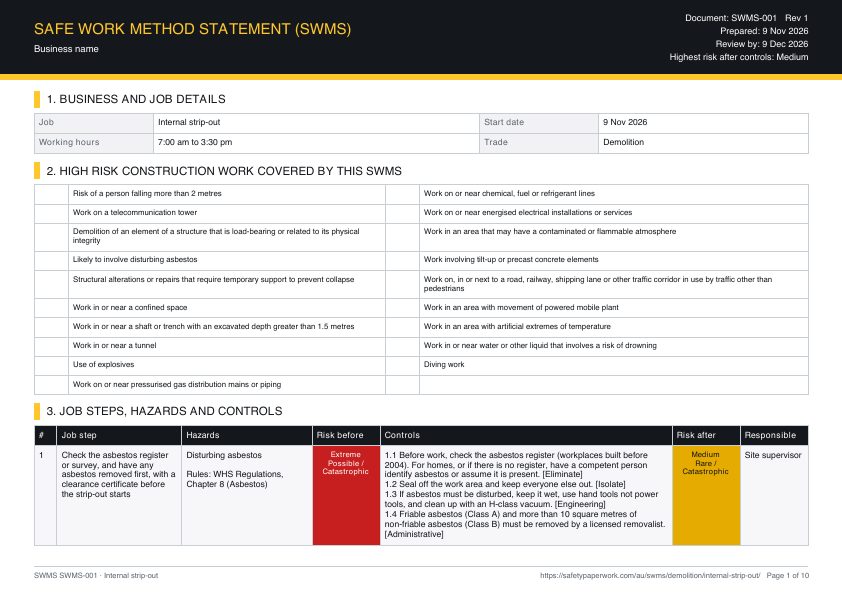
SWMS example: internal strip out
This is a complete SWMS for internal strip out, with 9 job steps. Open it in the builder to add your site, crew and signatures, change anything, and download a PDF. Or download the free Word template below and fill it in by hand.
High risk construction work covered
Job steps, hazards and controls
| # | Job step | Hazards | Risk before | Controls | Risk after |
|---|---|---|---|---|---|
| 1 | Check the asbestos register or survey, and have any asbestos removed first, with a clearance certificate before the strip-out starts |
| Extreme |
| Medium |
| 2 | Check for lead paint and other hazardous materials before work starts |
| High |
| Medium |
| 3 | Isolate and cap power, gas and water to the area, and confirm they are dead |
| Extreme |
| Medium |
| 4 | Seal the area from occupants, set up dust control and keep exits clear |
| High |
| Medium |
| 5 | Confirm which walls are load bearing and leave them alone without an engineer design |
| High |
| Medium |
| 6 | Strip fittings and linings from the top down, using a platform ladder or mobile scaffold for ceilings |
| High |
| Medium |
| 7 | Cut or break materials with dust extraction |
| Extreme |
| Medium |
| 8 | Watch for needles, droppings and mould in wall and ceiling cavities |
| Medium |
| Low |
| 9 | Load waste into the skip bin by hand or chute, keeping walkways clear |
| High |
| Medium |
PPE
Plant and equipment
Emergency
Call 000. Add the nearest hospital, the assembly point and the first aider for your site.
Sign-off
Supervisor and every worker sign to confirm they have read and understood this SWMS.
Free SWMS template for internal strip out
Word (.docx) and PDF, A4 landscape, no email needed. Fill in your site details, then print or send it.
Make yours in 2 minutes
Same document, filled in for your job. Answer a few yes or no questions, the crew signs on the phone, and you send the PDF.
Pre-start checklist for internal strip out
Tick these off before work starts. They come from the hazards, permits and equipment in this job.
- SWMS read, explained and signed by everyone on the job
- Ladder inspected, secured and extending 1 m above the landing
- Asbestos register or survey checked for the work area
- Water suppression or on-tool extraction fitted; respirators fit tested
- Exclusion zone below the work and public kept out
- First aider, first aid kit and emergency number (000) confirmed
- PPE checked and worn: steel cap boots, hard hat, safety glasses, P2 dust mask
The safe sequence of work
- Check the asbestos register or survey, and have any asbestos removed first, with a clearance certificate before the strip-out starts
- Check for lead paint and other hazardous materials before work starts
- Isolate and cap power, gas and water to the area, and confirm they are dead
- Seal the area from occupants, set up dust control and keep exits clear
- Confirm which walls are load bearing and leave them alone without an engineer design
- Strip fittings and linings from the top down, using a platform ladder or mobile scaffold for ceilings
- Cut or break materials with dust extraction
- Watch for needles, droppings and mould in wall and ceiling cavities
- Load waste into the skip bin by hand or chute, keeping walkways clear
Hazards to watch on internal strip out
The hazards most specific to this job, and the step where each one comes up.
What changes on your site
This example covers the job itself. Your site may add more. Add controls for any of these that apply (the builder asks you these as yes or no questions):
- Will anyone work more than 2 metres off the ground?
- Will anyone work on a roof?
- Is there a skylight, clear sheet, fibro or other fragile roofing?
- Will you use a scaffold or mobile tower?
- Will you use an EWP (scissor lift or boom lift)?
Why SWMS get rejected
Principal contractors send documents back for these reasons. This example avoids them, but check yours too.
- It is generic: another site address, tasks that are not on this job, or no sign it was reviewed for this site. WorkSafe WA says a generic SWMS may not meet the regulations unless it is reviewed and amended for the workplace.
- The HRCW boxes are not ticked, or the ticks do not match the tasks (for example a roof job with no falls box ticked).
- Falls are controlled only by "be careful", training or a harness, with no edge protection or scaffold and no reason why higher controls are not reasonably practicable.
- Workers will clip on to a harness but there is no rescue plan for someone left hanging.
- The "how controls are implemented, monitored and reviewed" part is missing, or it says the same thing on every row.
- No worker sign-on, no person responsible for compliance, or a date given to the principal contractor that is before they actually received it.
- Licence or White Card details are missing for workers operating plant or doing licensed high risk work.
Questions
Do I need a SWMS for internal strip out?
A SWMS is required by law if internal strip out includes any high risk construction work, such as working where someone could fall more than 2 metres. Many principal contractors ask for one either way.
Who signs the SWMS?
The person conducting the business (PCBU) or their supervisor prepares it with the workers, and every worker doing the high risk work signs to show they were consulted and understand it. Give a copy to the principal contractor before work starts.
How long do I keep it?
Keep this SWMS, and every revised version, until the high risk construction work is finished, where workers and inspectors can see it on site. If a notifiable incident happens during the work, keep it for at least 2 years after the incident.
What PPE is needed for internal strip out?
Usually Steel cap boots, Hard hat, Safety glasses, P2 dust mask, Cut-resistant gloves, Hearing protection (earmuffs or plugs), Half-face respirator (P2 or P3 filters), Overalls, Work gloves, Chemical-resistant gloves (nitrile), Safety goggles, Face shield. The site rules may add more, so check with the principal contractor.
More demolition SWMS
Related jobs in other trades
Toolbox talks for this job
Blank SWMS template: free SWMS templates. Also for other countries: United Kingdom (RAMS) · United States (JHA) · Canada (FLHA)