SafetyPaperwork
Roofing · Australia

SWMS for gutter replacement

Yes. Gutter replacement usually includes high risk construction work (risk of a person falling more than 2 metres; work in an area with movement of powered mobile plant), so a SWMS is required by law before work starts.

It must list the hazards, the controls and how they will be put in place, monitored and reviewed, and the workers must be consulted and sign before starting. The main hazards are falling from height, disturbing asbestos, EWP tip-over or crush and scaffold collapse or fall from scaffold.

SWMS example: gutter replacement

This is a complete SWMS for gutter replacement, with 9 job steps. Open it in the builder to add your site, crew and signatures, change anything, and download a PDF. Or download the free Word template below and fill it in by hand.

Safe Work Method Statement (SWMS)
Replace gutters and downpipes · Roofing · Example
Document SWMS-001 · Rev 1

High risk construction work covered

Risk of a person falling more than 2 metresWork in an area with movement of powered mobile plant

Job steps, hazards and controls

#Job stepHazardsRisk beforeControlsRisk after
1Barricade the area below and check for power lines near the gutter line
  • Public entering the work area
  • Contact with overhead power lines
  • Falling tools and materials
High
  • Fence off the site with secure temporary fencing and lock the gates when you leave. Isolate
  • Give pedestrians a safe, marked path around the work, with ramps for prams and wheelchairs. Isolate
  • Use hoarding, covered walkways or catch fans where work is above public areas. Engineering
  • Put signs at each entry: site name, contact number and "No unauthorised entry". Administrative
  • Make the site safe at the end of each day: cover holes, lower plant, remove ladders and lock tools away. Administrative
  • Ask the network operator to turn off, move or insulate the lines before work starts. Eliminate
  • Use non-conductive (fibreglass) ladders near any power lines. Substitute
  • Mark the safe distance with flags, tape or goal posts and keep all plant and people outside it. Isolate
  • Keep out of the No Go Zone set by your state and the network operator, or get written approval and a safety observer. In NSW and Qld, untrained people and plant stay at least 3 m from lines on poles up to 132 kV, 6 m up to 330 kV and 8 m above 330 kV. In Victoria the limits differ, and work within 8 m of tower lines needs a spotter and the network operator's permission. Administrative
  • Use a dedicated spotter whenever plant moves or raises anything near lines. Administrative
  • Treat all lines as live. If plant touches a line, stay in the cab and keep everyone well away. Administrative
  • Barricade and sign the drop zone under overhead work so nobody walks beneath. Isolate
  • Fit toe boards, kick plates and mesh screens on scaffolds and edges. Engineering
  • Falling tools and materials: see step 5 for the full controls Administrative
Medium
2Check old gutters, fascia and eaves sheeting for asbestos, and old paint for lead, before cutting
  • Disturbing asbestos
  • Lead paint dust and fumes
Extreme
  • Before work, check the asbestos register (workplaces built before 2004). For homes, or if there is no register, have a competent person identify asbestos or assume it is present. Eliminate
  • Seal off the work area and keep everyone else out. Isolate
  • If asbestos must be disturbed, keep it wet, use hand tools not power tools, and clean up with an H-class vacuum. Engineering
  • Friable asbestos (Class A) and more than 10 square metres of non-friable asbestos (Class B) must be removed by a licensed removalist. Administrative
  • Stop work straight away if you find suspect asbestos. Do not touch it and tell your supervisor. Administrative
  • Wear a fitted P2 (or better) respirator and disposable coveralls. PPE
  • Test old paint for lead before you sand, scrape, cut or heat it. Eliminate
  • Use wet scraping, chemical strippers or shrouded tools with extraction instead of dry sanding. Never burn off lead paint with an open flame. Substitute
  • Seal off the work area with plastic sheeting and keep residents, children and pets out. Isolate
  • Clean up with an H-class vacuum and wet wipes. Never dry sweep. Engineering
  • Wash hands and face before eating, drinking or smoking. Change out of dusty clothes before going home. Administrative
  • Wear a P2 (or better) respirator, disposable coveralls and gloves. PPE
Medium
3Set up a mobile scaffold, EWP or roof edge protection; use a secured ladder only for short, light work with three points of contact
  • Falling from height
  • Falling from a ladder
  • EWP tip-over or crush
  • Scaffold collapse or fall from scaffold
Extreme
  • Do the work from the ground where you can, for example pre-assemble on the ground or use extension poles. Eliminate
  • Install guardrails or edge protection on all open edges before work starts. Isolate
  • Use a scaffold, mobile work platform or EWP instead of working off a ladder. Engineering
  • Where edge protection is not practical, use a fall restraint or fall arrest system on a rated anchor point. Engineering
  • Everyone working at height holds a White Card and has been briefed on this SWMS before going up. Administrative
  • Use a platform ladder, mobile scaffold or EWP for longer jobs instead of a straight ladder. Substitute
  • Use industrial-rated ladders (AS/NZS 1892, 120 kg or more) in good condition. Remove any damaged ladder from site. Engineering
  • Set extension ladders at a 4 to 1 angle on firm, level ground, tied or footed, and reaching 1 metre above the landing. Engineering
  • Use ladders only for short, light work. Do not carry heavy or awkward loads up a ladder. Administrative
  • Check the ground before setting up. Use outriggers and spreader pads, and keep clear of trenches, pits and slopes. Engineering
  • Use a platform with tilt alarm and secondary guarding (anti-entrapment) where there is an overhead crush risk. Engineering
  • Hold a High Risk Work Licence (WP) for boom-type EWPs with a boom of 11 metres or more. Under 11 metres and scissor lifts: trained and assessed (for example EWPA Yellow Card). Administrative
  • Do a pre-start check each day. Keep a trained person on the ground who can lower the platform in an emergency. Administrative
  • Have a written emergency and rescue plan, tested before work starts, for a worker stuck in the platform or hanging in a harness (WHS Regulations r.80). Administrative
  • Never exceed the safe working load, climb on the rails or use a ladder in the basket. Administrative
  • Scaffold is built, altered and taken down only by a competent scaffolder, on a firm base with sole boards and ties. Engineering
  • Fit guardrails, mid rails and toe boards on every working platform. Engineering
  • Use mobile scaffolds only on firm, level ground with castors locked and outriggers fitted. Never move one with anyone on it. Engineering
  • Scaffold where a person or object could fall more than 4 metres is built by a licensed scaffolder (High Risk Work Licence). Administrative
  • Do not use a scaffold over 4 metres until the scaffolder gives a written handover certificate. Administrative
  • Inspect the scaffold before first use, after any change or bad weather, and at least every 30 days. Record it on the scaffold tag. Administrative
Medium
4Clean out the old gutter with gloves on, watching for sharp edges and wasp nests. Wet down any bird or possum droppings and wear a dust mask if there are a lot
  • Cuts from sharp edges
  • Bites and stings
Medium
  • Deburr or cover sharp edges, and fit edge protectors on exposed sheet metal. Engineering
  • Use knives with retractable or self-retracting blades. Engineering
  • Cut away from your body and keep your other hand clear. Administrative
  • Put used blades in a blade bin or sharps container. Administrative
  • Use two people to handle large sheets of metal or glass. Administrative
  • Wear cut-resistant gloves and long sleeves. PPE
  • Check work areas before starting, and get pest control to remove nests. Eliminate
  • Look before you reach into dark spaces. Administrative
  • Ask owners to keep pets away from the work area. Administrative
  • Know who has allergies and keep their medication, such as an adrenaline auto-injector, close by. Administrative
  • Know snake bite first aid: pressure immobilisation bandage, keep still and call 000. Administrative
  • Wear gloves, long sleeves and boots. Use insect repellent outdoors. PPE
Medium
5Cut old gutters into short lengths and lower them down; never drop them
  • Lifting and carrying heavy loads
  • Cuts from sharp edges
  • Falling tools and materials
High
  • Plan to avoid carrying: have materials delivered, and old items picked up, as close as possible to where they are used. Eliminate
  • Use lighter or smaller loads: order smaller bags and shorter lengths, and drain or break down old items before moving them. Substitute
  • Use trolleys, pallet jacks, hoists, vacuum lifters or plant instead of carrying by hand. Engineering
  • Use a two-person lift for anything heavy, long or awkward. Plan the route first and clear it. Administrative
  • Keep the load close, back straight and no twisting. Turn with your feet. Administrative
  • Cuts from sharp edges: see step 4 for the full controls Administrative
  • Barricade and sign the drop zone under overhead work so nobody walks beneath. Isolate
  • Fit toe boards, kick plates and mesh screens on scaffolds and edges. Engineering
  • Use catch fans, debris netting or covered walkways where people pass below. Engineering
  • Tether hand tools when working at height. Engineering
  • Keep platforms tidy. Do not stack materials near edges or above toe board height. Administrative
Medium
6Check the fascia is sound and replace any rotten sections before fixing brackets
  • Falling from height
  • Injury from power tools
  • Wood and MDF dust
Extreme
  • Have a written emergency and rescue plan, tested before work starts, so a worker hanging in a harness can be brought down within minutes (WHS Regulations r.80). Administrative
  • Wear a full body harness with a shock-absorbing lanyard, clipped on at all times when using fall arrest. PPE
  • Falling from height: see step 3 for the full controls Administrative
  • Keep all guards fitted and working. Never tie back or remove a guard. Engineering
  • Clamp or secure the work piece. Do not hold it by hand. Engineering
  • Only trained, competent people use power tools, following the maker's instructions. Administrative
  • Check tools before use. Unplug or remove the battery before changing blades or bits. Administrative
  • No loose clothing, jewellery or long hair near spinning parts. Administrative
  • Buy pre-cut or pre-finished timber where you can. Substitute
  • Cut outdoors or in a well-ventilated area away from others. Isolate
  • Use saws and sanders with dust extraction connected to an M-class (or better) vacuum. Engineering
  • Clean up with a vacuum, not a broom or compressed air. Administrative
  • Wear a P2 dust mask for cutting and sanding. PPE
Medium
7Fix brackets to the right fall, then fit the new gutter and downpipes, keeping tools tethered at height
  • Injury from power tools
  • Cuts from sharp edges
  • Falling tools and materials
  • Sun exposure (UV)
High
  • Wear safety glasses and hearing protection. Do not wear loose gloves on drills or other rotating tools. PPE
  • Injury from power tools: see step 6 for the full controls Administrative
  • Cuts from sharp edges: see step 4 for the full controls Administrative
  • Lower materials with a hoist, chute or rope. Never throw or drop anything down. Administrative
  • Wear a hard hat anywhere objects could fall. PPE
  • Falling tools and materials: see step 5 for the full controls Administrative
  • Plan outdoor work for early morning or late afternoon when UV is lower. Eliminate
  • Put shade covers over fixed work areas. Engineering
  • Check the UV index each day. Use sun protection when it is 3 or higher. Administrative
  • Check your skin regularly and see a doctor about any new or changing spots. Administrative
Medium
8Seal joints and connect downpipes to the stormwater system
  • Hazardous chemicals
  • Lifting and carrying heavy loads
High
  • Choose the least harmful product that does the job, for example water-based instead of solvent-based. Substitute
  • Use chemicals in well-ventilated areas, or use fans and extraction in closed rooms. Engineering
  • Read the Safety Data Sheet (SDS) before use and keep a register of hazardous chemicals on site. Administrative
  • Keep chemicals in labelled containers. Never decant into drink bottles. Administrative
  • Store chemicals away from heat, food and drink, and keep products that react with each other apart. Administrative
  • Have eye wash and a spill kit nearby, and wash hands before eating. Administrative
  • Wear chemical-resistant gloves and safety glasses or goggles as listed on the SDS. PPE
  • Use a respirator with the right cartridge if the SDS calls for one. PPE
  • Rotate tasks and take breaks on long lifting jobs. Administrative
  • Wear gloves for grip and safety boots to protect your feet. PPE
  • Lifting and carrying heavy loads: see step 5 for the full controls Administrative
Medium
9Water test the gutter, clean up swarf and offcuts, and remove access equipment
  • Poor housekeeping and waste
  • Slips and trips
Medium
  • Order materials to size and send packaging back where you can. Eliminate
  • Put skip bins and waste chutes close to the work. Engineering
  • Clean as you go, and do a full clean up at the end of each day. Administrative
  • Keep exits, stairs and walkways clear at all times. Administrative
  • Stack materials neatly on level ground, away from edges. Administrative
  • Wear gloves when handling waste. PPE
  • Plan walkways and keep them clear of materials, hoses and leads. Eliminate
  • Run leads and hoses overhead on hooks or stands, or along walls, not across walkways. Engineering
  • Fill or cover holes, and lay boards or mats on muddy access paths. Engineering
  • Clean up offcuts, packaging and spills as you go, not at the end of the day. Administrative
  • Keep work areas, stairs and access paths well lit. Administrative
  • Wear safety boots with good grip, laced up. PPE
Low

PPE

Steel cap bootsCut-resistant glovesSafety glassesSun protection (brim hat, long sleeves, SPF 50+)Hi-vis shirt or vestHard hatHalf-face respirator (P2 or P3 filters)OverallsWork glovesSafety harness and lanyardHearing protection (earmuffs or plugs)P2 dust maskChemical-resistant gloves (nitrile)Safety goggles

Plant and equipment

Extension ladderMobile scaffold: Scaffolding HRWL (SB or higher) to erect, alter or dismantle where a person or object could fall more than 4 mScissor lift (EWP): Trained and assessed for the EWP type (e.g. EWPA Yellow Card)Hand toolsPower drill

Permits and plans

Working at heights permit

Emergency

Call 000. Add the nearest hospital, the assembly point and the first aider for your site.

Sign-off

Supervisor and every worker sign to confirm they have read and understood this SWMS.
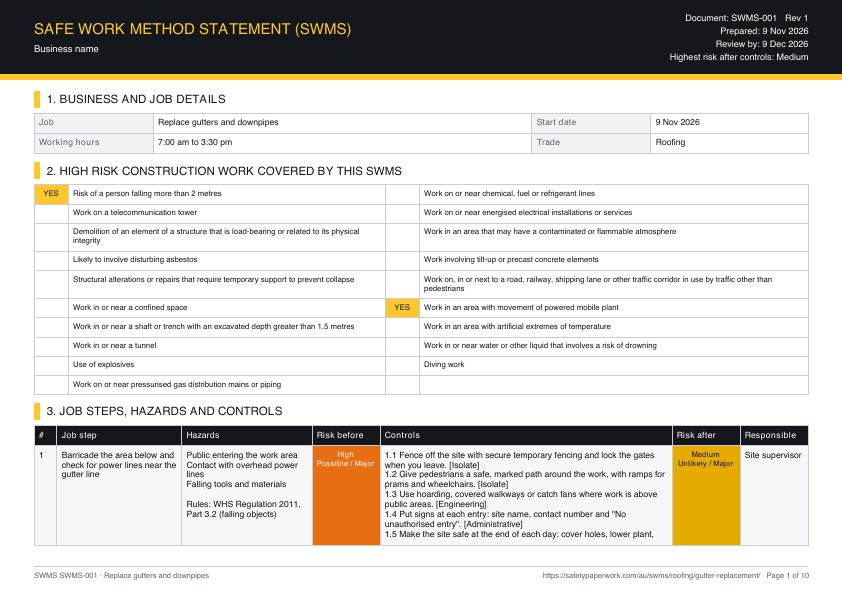
Page 1 of the free gutter replacement SWMS template: business details, high risk construction work and job steps with hazards, risk ratings and controls

Free SWMS template for gutter replacement

Word (.docx) and PDF, A4 landscape, no email needed. Fill in your site details, then print or send it.

Make yours in 2 minutes

Same document, filled in for your job. Answer a few yes or no questions, the crew signs on the phone, and you send the PDF.

Start this SWMS

Pre-start checklist for gutter replacement

Tick these off before work starts. They come from the hazards, permits and equipment in this job.

The safe sequence of work

  1. Barricade the area below and check for power lines near the gutter line
  2. Check old gutters, fascia and eaves sheeting for asbestos, and old paint for lead, before cutting
  3. Set up a mobile scaffold, EWP or roof edge protection; use a secured ladder only for short, light work with three points of contact
  4. Clean out the old gutter with gloves on, watching for sharp edges and wasp nests. Wet down any bird or possum droppings and wear a dust mask if there are a lot
  5. Cut old gutters into short lengths and lower them down; never drop them
  6. Check the fascia is sound and replace any rotten sections before fixing brackets
  7. Fix brackets to the right fall, then fit the new gutter and downpipes, keeping tools tethered at height
  8. Seal joints and connect downpipes to the stormwater system
  9. Water test the gutter, clean up swarf and offcuts, and remove access equipment

Hazards to watch on gutter replacement

The hazards most specific to this job, and the step where each one comes up.

Step 4Bites and stingsSnakes, spiders, wasps and bees in roof spaces, under floors and in long grass bite or sting workers.
Step 6Wood and MDF dustSawing and sanding timber, MDF and treated wood makes fine dust that causes asthma, skin problems and some cancers.
Step 3EWP tip-over or crushThe platform tips on soft or sloping ground, the worker is crushed against a beam or ceiling, or is thrown out of the basket.
Step 2Lead paint dust and fumesPaint on buildings built before 1970 is likely to contain lead, and anything before 1997 may. Sanding, scraping or heating it releases dust or fumes that poison workers and families, especially children.
Step 3Scaffold collapse or fall from scaffoldA scaffold that is badly built, overloaded or altered collapses or tips, or a worker falls from an unguarded platform.
Step 7Sun exposure (UV)Long hours in the sun cause sunburn, eye damage and skin cancer.
Almost certainLikelyPossibleUnlikelyRareHow bad it could be: Insignificant to CatastrophicBA
Highest risk on gutter replacement: Extreme before controls (B), down to Medium after controls (A), on the Australia 5 by 5 risk matrix (likely and catastrophic becomes unlikely and major).

What changes on your site

This example covers the job itself. Your site may add more. Add controls for any of these that apply (the builder asks you these as yes or no questions):

  • Will anyone work on a roof?
  • Is there a skylight, clear sheet, fibro or other fragile roofing?
  • Will you cut, grind or drill concrete, brick, stone, tiles or fibre cement?
  • Will you remove, cut, repair or dispose of an existing engineered stone benchtop?
  • Will you use chemicals, solvents, glues, paints or fuels?

Licences and legal requirements in Australia

This task can involve these high risk construction work categories under the WHS Regulations:

  • Risk of a person falling more than 2 metres
  • Work in an area with movement of powered mobile plant

Equipment on this job that needs a licence, ticket or training:

  • Mobile scaffold: Scaffolding HRWL (SB or higher) to erect, alter or dismantle where a person or object could fall more than 4 m
  • Scissor lift (EWP): Trained and assessed for the EWP type (e.g. EWPA Yellow Card)

A SWMS must be prepared before any high risk construction work starts. It must list the high risk work, the hazards and risks, the control measures, and how those controls will be put in place, monitored and reviewed. It must be easy for the workers to read and understand.

Rules that apply: WHS Regulation 2011, Part 3.2 (falling objects); WHS Regulations, Chapter 8 (Asbestos); WHS Regulation 2011, Part 7.2 Lead; WHS Regulation 2011, Part 4.4 Falls; WHS Regulation 2011, Part 4.5 High risk work; WHS Regulation 2011, Part 4.4 Falls, Part 5.1 Plant and r.225 (scaffolds); WHS Regulation 2011, Part 4.2 Hazardous manual tasks; WHS Regulation 2011, Chapter 7 Hazardous chemicals.

Each state has its own regulator and some extra rules: New South Wales, Victoria, Queensland, Western Australia, South Australia and Australian Capital Territory.

Why SWMS get rejected

Principal contractors send documents back for these reasons. This example avoids them, but check yours too.

  • It is generic: another site address, tasks that are not on this job, or no sign it was reviewed for this site. WorkSafe WA says a generic SWMS may not meet the regulations unless it is reviewed and amended for the workplace.
  • The HRCW boxes are not ticked, or the ticks do not match the tasks (for example a roof job with no falls box ticked).
  • Falls are controlled only by "be careful", training or a harness, with no edge protection or scaffold and no reason why higher controls are not reasonably practicable.
  • Workers will clip on to a harness but there is no rescue plan for someone left hanging.
  • The "how controls are implemented, monitored and reviewed" part is missing, or it says the same thing on every row.
  • No worker sign-on, no person responsible for compliance, or a date given to the principal contractor that is before they actually received it.
  • Licence or White Card details are missing for workers operating plant or doing licensed high risk work.

Questions

Do I need a SWMS for gutter replacement?

Yes. Gutter replacement usually includes high risk construction work (risk of a person falling more than 2 metres; work in an area with movement of powered mobile plant), so a SWMS is required by law before work starts.

Who signs the SWMS?

The person conducting the business (PCBU) or their supervisor prepares it with the workers, and every worker doing the high risk work signs to show they were consulted and understand it. Give a copy to the principal contractor before work starts.

How long do I keep it?

Keep this SWMS, and every revised version, until the high risk construction work is finished, where workers and inspectors can see it on site. If a notifiable incident happens during the work, keep it for at least 2 years after the incident.

What PPE is needed for gutter replacement?

Usually Steel cap boots, Cut-resistant gloves, Safety glasses, Sun protection (brim hat, long sleeves, SPF 50+), Hi-vis shirt or vest, Hard hat, Half-face respirator (P2 or P3 filters), Overalls, Work gloves, Safety harness and lanyard, Hearing protection (earmuffs or plugs), P2 dust mask, Chemical-resistant gloves (nitrile), Safety goggles. The site rules may add more, so check with the principal contractor.

More roofing SWMS

Related jobs in other trades

Toolbox talks for this job

Blank SWMS template: free SWMS templates. Also for other countries: United Kingdom (RAMS) · United States (JHA) · Canada (FLHA)

Sources