SWMS for concrete cutting and core drilling
A SWMS is required by law if concrete cutting and core drilling includes any high risk construction work, such as working where someone could fall more than 2 metres. Many principal contractors ask for one either way.
It must list the hazards, the controls and how they will be put in place, monitored and reviewed, and the workers must be consulted and sign before starting. The main hazards are silica dust from concrete, brick, stone and tiles, electric shock from live wiring, hitting underground services and falling through a floor opening or void.
SWMS example: concrete cutting and core drilling
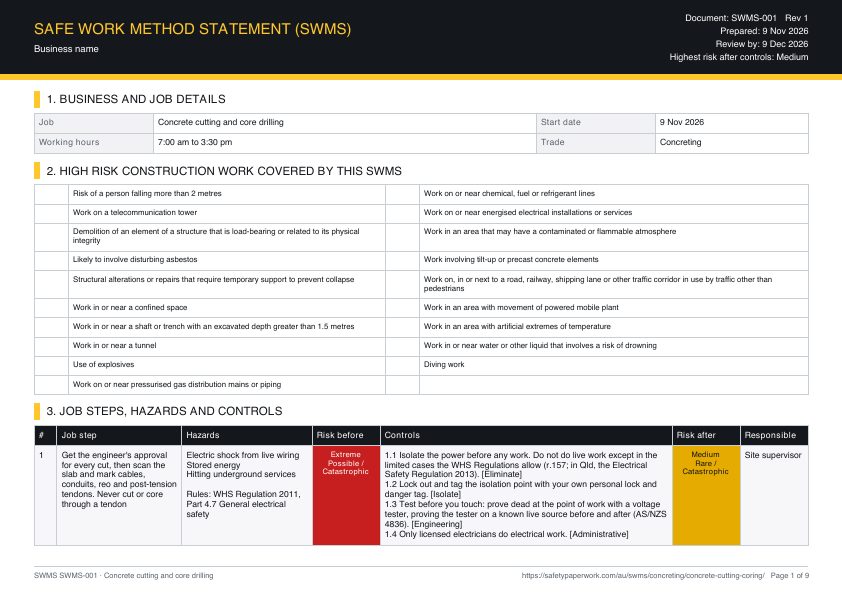
This is a complete SWMS for concrete cutting and core drilling, with 8 job steps. Open it in the builder to add your site, crew and signatures, change anything, and download a PDF. Or download the free Word template below and fill it in by hand.
High risk construction work covered
Job steps, hazards and controls
| # | Job step | Hazards | Risk before | Controls | Risk after |
|---|---|---|---|---|---|
| 1 | Get the engineer's approval for every cut, then scan the slab and mark cables, conduits, reo and post-tension tendons. Never cut or core through a tendon |
| Extreme |
| Medium |
| 2 | Set an exclusion zone, including the floor below for coring, and keep occupants out |
| High |
| Medium |
| 3 | Plan where the water and slurry will go and keep leads off wet ground, using RCD protection |
| High |
| Low |
| 4 | Check the blade or bit, guard and water feed before starting |
| High |
| Medium |
| 5 | Fix the core drill rig with an anchor or vacuum base so it cannot spin |
| High |
| Medium |
| 6 | Cut with water suppression or extraction, never dry cut. Indoors, use electric or hydraulic saws; never run petrol saws or generators inside (carbon monoxide) |
| Extreme |
| Medium |
| 7 | Support cut pieces and cores so they do not drop or pinch the blade |
| High |
| Medium |
| 8 | Cover or guard new holes, vacuum slurry and clean up |
| Extreme |
| Medium |
PPE
Plant and equipment
Permits and plans
Emergency
Call 000. Add the nearest hospital, the assembly point and the first aider for your site.
Sign-off
Supervisor and every worker sign to confirm they have read and understood this SWMS.
Free SWMS template for concrete cutting and core drilling
Word (.docx) and PDF, A4 landscape, no email needed. Fill in your site details, then print or send it.
Make yours in 2 minutes
Same document, filled in for your job. Answer a few yes or no questions, the crew signs on the phone, and you send the PDF.
Pre-start checklist for concrete cutting and core drilling
Tick these off before work starts. They come from the hazards, permits and equipment in this job.
- SWMS read, explained and signed by everyone on the job
- Openings, voids and penetrations covered and marked
- Isolation, lockout and test for dead done before work starts
- BYDA plans on site and services located
- Water suppression or on-tool extraction fitted; respirators fit tested
- Exclusion zone below the work and public kept out
- First aider, first aid kit and emergency number (000) confirmed
- PPE checked and worn: steel cap boots, safety glasses, hearing protection (earmuffs or plugs), P2 dust mask
The safe sequence of work
- Get the engineer's approval for every cut, then scan the slab and mark cables, conduits, reo and post-tension tendons. Never cut or core through a tendon
- Set an exclusion zone, including the floor below for coring, and keep occupants out
- Plan where the water and slurry will go and keep leads off wet ground, using RCD protection
- Check the blade or bit, guard and water feed before starting
- Fix the core drill rig with an anchor or vacuum base so it cannot spin
- Cut with water suppression or extraction, never dry cut. Indoors, use electric or hydraulic saws; never run petrol saws or generators inside (carbon monoxide)
- Support cut pieces and cores so they do not drop or pinch the blade
- Cover or guard new holes, vacuum slurry and clean up
Hazards to watch on concrete cutting and core drilling
The hazards most specific to this job, and the step where each one comes up.
What changes on your site
This example covers the job itself. Your site may add more. Add controls for any of these that apply (the builder asks you these as yes or no questions):
- Will anyone work more than 2 metres off the ground?
- Will anyone use a ladder or stepladder?
- Will anyone work on a roof?
- Is there a skylight, clear sheet, fibro or other fragile roofing?
- Will you use a scaffold or mobile tower?
Why SWMS get rejected
Principal contractors send documents back for these reasons. This example avoids them, but check yours too.
- It is generic: another site address, tasks that are not on this job, or no sign it was reviewed for this site. WorkSafe WA says a generic SWMS may not meet the regulations unless it is reviewed and amended for the workplace.
- The HRCW boxes are not ticked, or the ticks do not match the tasks (for example a roof job with no falls box ticked).
- Falls are controlled only by "be careful", training or a harness, with no edge protection or scaffold and no reason why higher controls are not reasonably practicable.
- Workers will clip on to a harness but there is no rescue plan for someone left hanging.
- The "how controls are implemented, monitored and reviewed" part is missing, or it says the same thing on every row.
- No worker sign-on, no person responsible for compliance, or a date given to the principal contractor that is before they actually received it.
- Licence or White Card details are missing for workers operating plant or doing licensed high risk work.
Questions
Do I need a SWMS for concrete cutting and core drilling?
A SWMS is required by law if concrete cutting and core drilling includes any high risk construction work, such as working where someone could fall more than 2 metres. Many principal contractors ask for one either way.
Who signs the SWMS?
The person conducting the business (PCBU) or their supervisor prepares it with the workers, and every worker doing the high risk work signs to show they were consulted and understand it. Give a copy to the principal contractor before work starts.
How long do I keep it?
Keep this SWMS, and every revised version, until the high risk construction work is finished, where workers and inspectors can see it on site. If a notifiable incident happens during the work, keep it for at least 2 years after the incident.
What PPE is needed for concrete cutting and core drilling?
Usually Steel cap boots, Safety glasses, Hearing protection (earmuffs or plugs), P2 dust mask, Work gloves, Hard hat, Hi-vis shirt or vest, Half-face respirator (P2 or P3 filters). The site rules may add more, so check with the principal contractor.
More concreting SWMS
Related jobs in other trades
Toolbox talks for this job
Blank SWMS template: free SWMS templates. Also for other countries: United Kingdom (RAMS) · United States (JHA) · Canada (FLHA)