Method statement for consumer unit replacement
You must assess the risks of consumer unit replacement and record the significant findings if you employ 5 or more people. On CDM sites the principal contractor will ask for RAMS before you start.
RAMS cover the hazards, who could be harmed and how, the controls and the safe sequence of work, and the crew is briefed and signs. The main hazards are disturbing asbestos, electric shock from live wiring, lifting and carrying heavy loads and falling from a ladder.
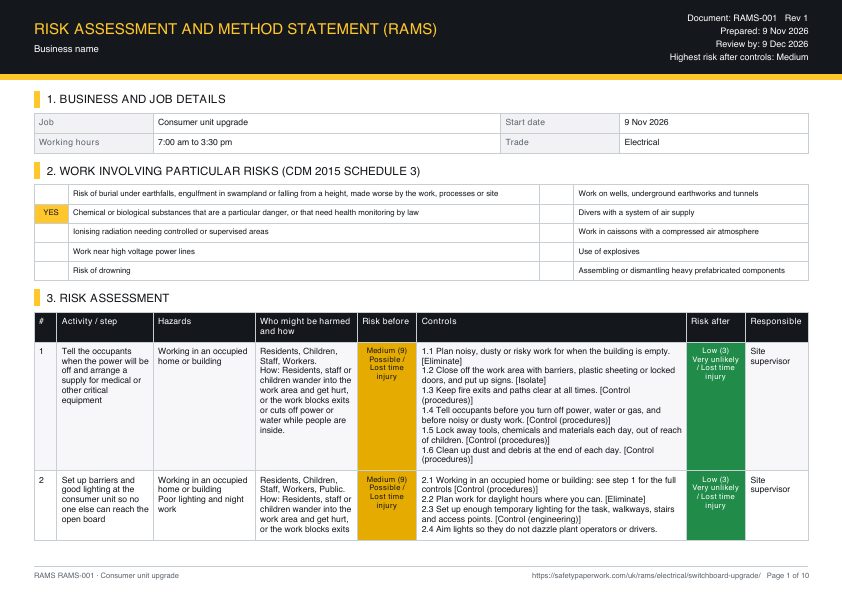
RAMS example: consumer unit replacement
This is a complete RAMS for consumer unit replacement, with 10 job steps. Open it in the builder to add your site, crew and signatures, change anything, and download a PDF. Or download the free Word template below and fill it in by hand.
Risk assessment
| # | Activity | Hazards | Who might be harmed | Risk before | Controls | Risk after |
|---|---|---|---|---|---|---|
| 1 | Tell the occupants when the power will be off and arrange a supply for medical or other critical equipment |
| Residents, Children, Staff, Workers | Medium (9) |
| Low (3) |
| 2 | Set up barriers and good lighting at the consumer unit so no one else can reach the open board |
| Residents, Children, Staff, Workers, Public | Medium (9) |
| Low (3) |
| 3 | Check the old consumer unit backing board and surrounds for asbestos |
| Workers, Occupants, Public | Very high (15) |
| Medium (5) |
| 4 | Agree how the supply will be isolated: switch off a double-pole isolator if one is fitted, or have the DNO (or someone with the DNO's written permission) withdraw the cut-out fuse. Never break a seal without permission. Then lock off and label, and prove dead. Treat the cut-out and meter tails as live until the supply is off |
| Workers, Occupants | Very high (15) |
| Medium (5) |
| 5 | With the supply proved dead, test the existing circuits (insulation resistance and continuity) and check the main earthing and main protective bonding, so faults are found and recorded before the new board goes in |
| Workers, Occupants | Very high (15) |
| Medium (5) |
| 6 | Remove the old consumer unit, labelling every circuit as it comes off |
| Workers, Occupants | Very high (15) |
| Medium (6) |
| 7 | Mount the new consumer unit, which must have a non-combustible (metal) enclosure in a home (BS 7671 reg 421.1.201), drilling with dust control and working from a stable step |
| Workers, People nearby, Occupants | High (12) |
| Medium (8) |
| 8 | Terminate circuits with RCD protection and tighten connections to the right torque |
| Workers | High (12) |
| Medium (6) |
| 9 | Do the dead tests before re-energising (continuity of protective conductors, insulation resistance, polarity). Then energise and do the live tests (earth fault loop impedance, prospective fault current, RCD operation) with GS38 test leads |
| Workers, Occupants | Very high (15) |
| Medium (5) |
| 10 | Label the consumer unit, clean up and give the customer an Electrical Installation Certificate to BS 7671:2018+A4:2026. In England and Wales a consumer unit replacement is notifiable under Part P: register it through your competent person scheme, or tell building control before work starts |
| Workers, Occupants, Visitors | Very high (15) |
| Medium (5) |
Method statement: sequence of work
- Tell the occupants when the power will be off and arrange a supply for medical or other critical equipment
- Set up barriers and good lighting at the consumer unit so no one else can reach the open board
- Check the old consumer unit backing board and surrounds for asbestos
- Agree how the supply will be isolated: switch off a double-pole isolator if one is fitted, or have the DNO (or someone with the DNO's written permission) withdraw the cut-out fuse. Never break a seal without permission. Then lock off and label, and prove dead. Treat the cut-out and meter tails as live until the supply is off
- With the supply proved dead, test the existing circuits (insulation resistance and continuity) and check the main earthing and main protective bonding, so faults are found and recorded before the new board goes in
- Remove the old consumer unit, labelling every circuit as it comes off
- Mount the new consumer unit, which must have a non-combustible (metal) enclosure in a home (BS 7671 reg 421.1.201), drilling with dust control and working from a stable step
- Terminate circuits with RCD protection and tighten connections to the right torque
- Do the dead tests before re-energising (continuity of protective conductors, insulation resistance, polarity). Then energise and do the live tests (earth fault loop impedance, prospective fault current, RCD operation) with GS38 test leads
- Label the consumer unit, clean up and give the customer an Electrical Installation Certificate to BS 7671:2018+A4:2026. In England and Wales a consumer unit replacement is notifiable under Part P: register it through your competent person scheme, or tell building control before work starts
PPE
Plant and equipment
Permits and plans
Emergency
Call 999. Add the nearest A&E, the assembly point and the first aider for your site.
Sign-off
Supervisor and every worker sign to confirm they have read and understood this RAMS.
Free RAMS template for consumer unit replacement
Word (.docx) and PDF, A4 landscape, no email needed. Fill in your site details, then print or send it.
Make yours in 2 minutes
Same document, filled in for your job. Answer a few yes or no questions, the crew signs on the phone, and you send the PDF.
Pre-start checklist for consumer unit replacement
Tick these off before work starts. They come from the hazards, permits and equipment in this job.
- RAMS read, explained and signed by everyone on the job
- Ladder inspected, secured and extending 1 m above the landing
- Isolation, lockout and test for dead done before work starts
- Asbestos register or survey checked for the work area
- First aider, first aid kit and emergency number (999) confirmed
- PPE checked and worn: safety boots, safety glasses, insulated electrical gloves, arc-rated clothing and face shield
The safe sequence of work
- Tell the occupants when the power will be off and arrange a supply for medical or other critical equipment
- Set up barriers and good lighting at the consumer unit so no one else can reach the open board
- Check the old consumer unit backing board and surrounds for asbestos
- Agree how the supply will be isolated: switch off a double-pole isolator if one is fitted, or have the DNO (or someone with the DNO's written permission) withdraw the cut-out fuse. Never break a seal without permission. Then lock off and label, and prove dead. Treat the cut-out and meter tails as live until the supply is off
- With the supply proved dead, test the existing circuits (insulation resistance and continuity) and check the main earthing and main protective bonding, so faults are found and recorded before the new board goes in
- Remove the old consumer unit, labelling every circuit as it comes off
- Mount the new consumer unit, which must have a non-combustible (metal) enclosure in a home (BS 7671 reg 421.1.201), drilling with dust control and working from a stable step
- Terminate circuits with RCD protection and tighten connections to the right torque
- Do the dead tests before re-energising (continuity of protective conductors, insulation resistance, polarity). Then energise and do the live tests (earth fault loop impedance, prospective fault current, RCD operation) with GS38 test leads
- Label the consumer unit, clean up and give the customer an Electrical Installation Certificate to BS 7671:2018+A4:2026. In England and Wales a consumer unit replacement is notifiable under Part P: register it through your competent person scheme, or tell building control before work starts
Hazards to watch on consumer unit replacement
The hazards most specific to this job, and the step where each one comes up.
What changes on your site
This example covers the job itself. Your site may add more. Add controls for any of these that apply (the builder asks you these as yes or no questions):
- Will anyone work at height, anywhere a fall could hurt them?
- Will anyone work on a roof?
- Is there a fragile roof, skylight or clear roof sheet?
- Will you use a scaffold or mobile tower?
- Will you use a MEWP (scissor lift or cherry picker)?
Why RAMS get rejected
Principal contractors send documents back for these reasons. This example avoids them, but check yours too.
- The method statement is only a list of headings that repeats the risk table and never says how the work is done.
- The method sequence does not match the risk assessment, for example the method strips the roof before the scaffold is handed over.
- Residual risk is still High after controls with no extra measures or explanation.
- It reads as copied: another firm, another address, or wording that does not fit UK sites. HSE warns that copying an example and adding your name does not satisfy the law.
- Work on an older building with no reference to an asbestos survey.
- Plant and access equipment listed with no inspection, thorough examination or competence evidence.
- No briefing record, no revision history, or no named supervisor.
Questions
Do I need RAMS for consumer unit replacement?
You must assess the risks of consumer unit replacement and record the significant findings if you employ 5 or more people. On CDM sites the principal contractor will ask for RAMS before you start.
Who signs the RAMS?
The person who wrote it and the person who approved it sign and date it. Every worker signs the briefing register after it is explained to them, and the principal contractor reviews and accepts it before you start.
How long do I keep it?
Keep this RAMS, every revision and the signed briefing register with the site file for the length of the job, and keep a copy in your records afterwards.
What PPE is needed for consumer unit replacement?
Usually Safety boots, Safety glasses, Insulated electrical gloves, Arc-rated clothing and face shield, FFP3 dust mask, Hi-vis vest, Half-mask respirator (P3 filters), Coveralls, Rigger gloves, Cut-resistant gloves, Ear defenders, Safety helmet, Knee pads. The site rules may add more, so check with the principal contractor.
More electrical RAMS
Related jobs in other trades
Toolbox talks for this job
Blank RAMS template: free RAMS templates. Also for other countries: Australia (SWMS) · United States (JHA) · Canada (FLHA)